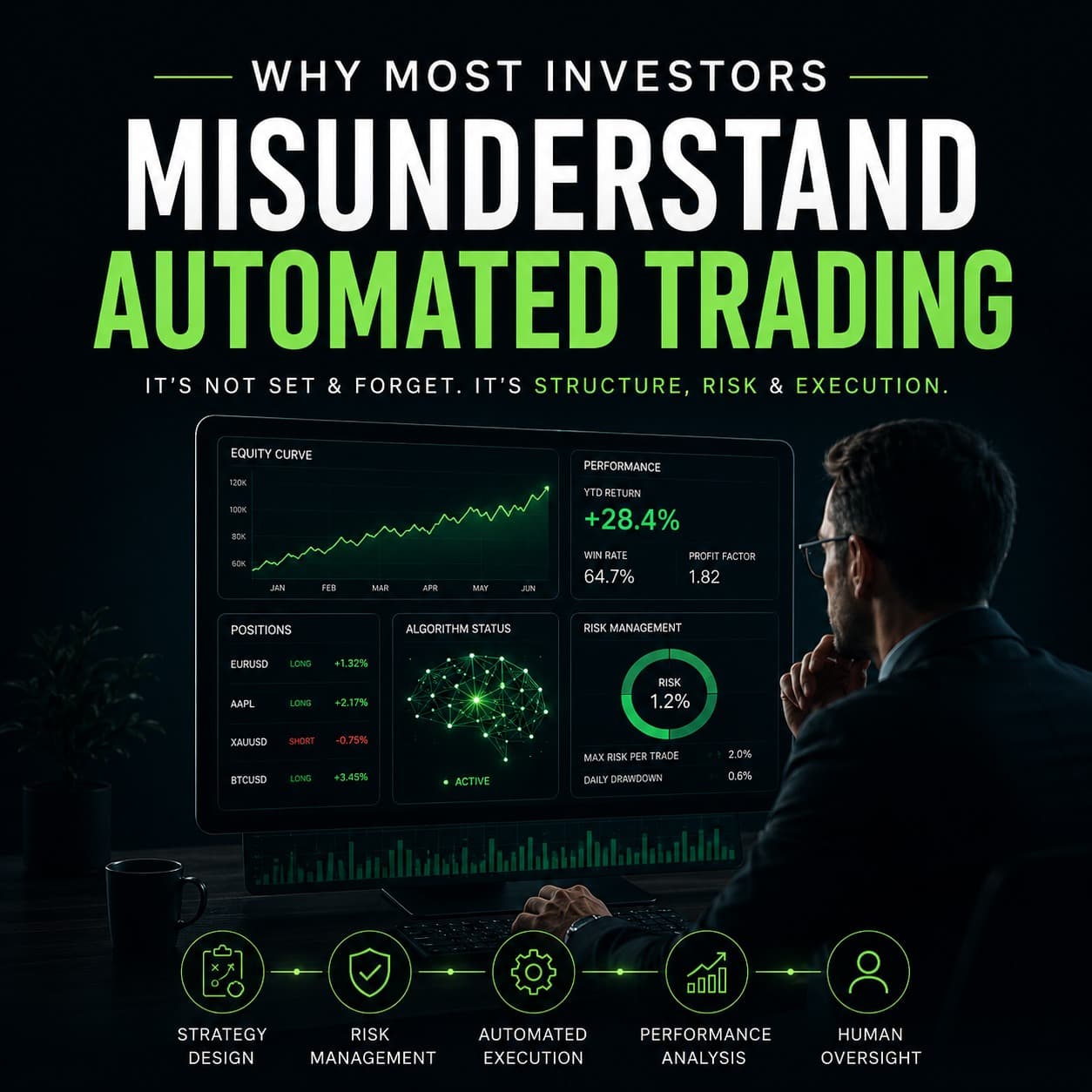
🧠 Why Most Investors Misunderstand Automated Trading
Automated trading is often presented as a simple solution.
Set it up.
Turn it on.
Let it trade.
Earn returns.
But this is only part of the story.
What most investors miss is not the performance - but the structure behind it.
A trading system is not a profit machine.
It is a structured execution system that follows predefined rules under changing market conditions.
👉 Structure matters more than outcome.
This idea is closely related to structure-first investing, where decisions are based on system behavior rather than short-term results.
Why Automated Trading Is Often Misunderstood
Most automated trading systems look effective at first glance.
Backtests show smooth growth.
Marketing shows high returns.
Demos show perfect execution.
But these are controlled environments.
Real markets are not.
Conditions change constantly:
- Volatility shifts
- Liquidity changes
- Slippage appears
- Execution delays happen
- News impacts behavior
A system that performs well in a backtest may behave completely differently in live markets.
This is where most misunderstandings happen.
Investors evaluate results, not system behavior.
Direct Answer
What should you understand before using automated trading?
You should understand structure - including strategy logic, risk limits, execution rules, live vs backtest behavior, transparency, human override options, failure conditions, and system weaknesses - not just historical performance.
Automation vs Passive Investing: Core Difference
Automation only handles execution.
It does not remove responsibility.
It does not remove risk.
It does not remove decision-making.
It only removes manual order placement.
What Automation Actually Does (and Does Not Do)
Automation can:
- Execute trades automatically
- Follow predefined rules
- Remove emotional execution errors
But automation cannot:
- Guarantee results
- Adapt intelligently without design
- Remove market risk
- Replace strategy logic
Execution Automation vs Decision Responsibility
Automation = execution layer
Investor = decision layer
Even in fully automated systems:
- Strategy is still human-designed
- Risk rules are still defined
- System behavior must still be monitored
Why Risk Still Exists in Automated Systems
Risk does not disappear with automation.
It changes form.
Risk still comes from:
- Market volatility
- Liquidity conditions
- Execution delays
- System design flaws
- Unexpected market events
Automation does not eliminate these factors.
It only executes decisions faster.
The Role of Structure in Automated Trading
The performance of any automated system depends on structure:
- How the strategy behaves
- How risk is controlled
- How trades are executed
- How it responds to market change
Without structure, automation becomes uncontrolled execution.
Why Oversight Is Still Required
- Market conditions change
- Strategy performance can degrade
- Execution can deviate
- Risk exposure can shift
Automation reduces workload - it does not remove oversight.
Common Misconceptions About Automation
- Automation means passive income
- Systems run independently forever
- Backtests guarantee future performance
- No monitoring is required
These assumptions are incorrect.
Active vs Passive Investing Through a Structural Lens
Passive investing reduces decision-making complexity.
Automated trading does not.
It still requires:
- System selection
- Risk understanding
- Performance evaluation
- Ongoing awareness
How SmartT Fits Into Automated Trading
SmartT represents automated participation rather than passive investing.
While execution can be automated, investors still need to understand structure, risk exposure, and system behavior over time in real market conditions.
SmartT represents automated participation rather than passive investing.
While execution can be automated, investors still need to understand structure, risk exposure, and system behavior over time in real market conditions.
Real-World Edge Example
In practice, automated trading systems may perform well in trending market conditions where price direction is stable.
However, when market conditions shift into high-volatility news events, execution behavior can change significantly.
Strategies that work in trend-driven environments may fail during liquidity spikes, where slippage and execution delays distort expected outcomes.
This shows that performance depends on market structure, not just system design.
Practical Evaluation Checklist for Automated Trading
- Is strategy logic clearly defined?
- What market conditions does it depend on?
- How is risk controlled?
- Does position sizing change dynamically?
- How does execution behave in live markets?
- Is there live performance history?
- Does it differ from backtest behavior?
- Can it be overridden?
- What are failure conditions?
- Is the system transparent?
Frequently Asked Questions
Is automated trading the same as passive investing?
No. Automated trading executes trades automatically, but strategy design, risk management, and oversight are still required.
Does automated trading remove responsibility from the investor?
No. Automation reduces manual execution but does not remove decision-making responsibility or risk exposure.
Is automated trading fully hands-off?
No. It reduces workload but still requires monitoring and system understanding.
Why is automated trading not considered passive investing?
Because performance still depends on structure, risk exposure, and system behavior under real market conditions.
Is automated trading safe for beginners?
It depends on system design, risk controls, and understanding of how the system behaves.
Closing Insight
A trading system is not a shortcut.
It is a structured execution framework that behaves under real pressure.
Survival depends on structure - not performance charts.
👉 Understanding how automation works in real markets helps investors avoid confusing execution automation with passive investing.
 Written by