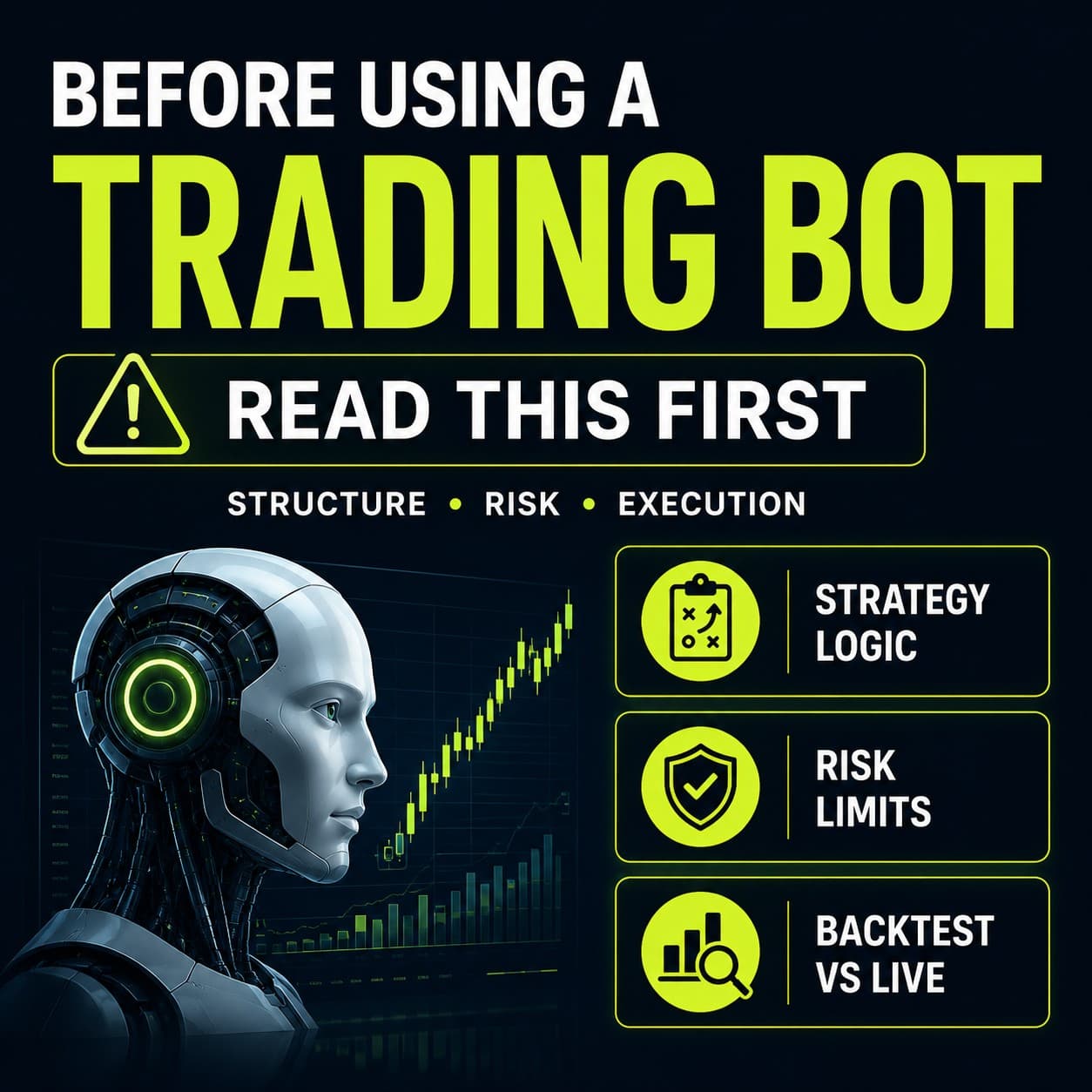
🧠 Before Using a Trading Bot - Read This First
Trading bots are often presented as a simple solution.
Set it up.
Turn it on.
Let it trade.
Earn returns.
But this is only part of the story.
What most traders miss is not the performance - but the structure behind it.
A trading bot is not a profit machine.
It is a structured execution system that follows predefined rules under changing market conditions.
Structure matters more than outcome.
This concept is closely related to structure-first investing, where decisions are based on system behavior rather than short-term outcomes.
It also connects directly to how investors should think about
👉 structure-first investing
Why Trading Bot Evaluation Is Often Misleading
Most trading bots look impressive at first glance.
Backtests show smooth growth.
Marketing shows high returns.
Demos show perfect execution.
But these are controlled environments.
Real markets are not.
Conditions change constantly:
- Volatility shifts
- Liquidity changes
- Slippage appears
- Execution delays happen
- News impacts behavior
A system that looks perfect in a backtest may behave completely differently in live markets.
This is where most evaluation mistakes happen.
Users evaluate results, not system behavior.
Direct Answer
What should you check before using a trading bot?
You should evaluate structure - strategy logic, risk limits, execution rules, live vs backtest behavior, transparency, human override options, failure conditions, and common mistakes - not just historical performance.
Trading Bot Structure: What Actually Matters
A trading bot must be evaluated as a system, not a product.
1. Strategy Logic
What triggers a trade?
What market condition does it rely on?
Is it fixed or adaptive?
2. Market Conditions Compatibility
- Trending markets
- Sideways markets
- News volatility
- Low liquidity periods
3. Risk Limits
Position sizing, drawdown control, loss behavior.
4. Execution Rules
Entry precision, slippage handling, real-time execution behavior.
5. Live vs Backtest
Consistency between simulated and real trading results.
6. Human Override
Pause, adjust, manual intervention ability.
7. Transparency
Clear logic vs black-box system.
8. Failure Conditions
When and how the system breaks or stops.
Why Backtests Are Not Enough
Backtests show what could have happened.
They do not include:
- Slippage
- Execution delays
- Market shocks
- Liquidity changes
- Psychological pressure
A smooth equity curve does not guarantee real-world stability.
👉 Real markets reveal structure - not simulations.
Real-World Example
A trading bot may show strong performance in backtests during stable market conditions.
However, in live trading, the same system can fail when unexpected news events increase volatility.
In such conditions:
- Slippage increases
- Execution becomes inconsistent
- Trade outcomes deviate from expectations
This creates a gap between backtest results and real behavior.
Structure-First Evaluation Mindset
The correct question is not:
How much does this bot make?
The correct question is:
How does this system behave under real conditions?
Should You Even Use a Trading Bot?
Before using one, consider:
- Do you understand how it makes decisions?
- Are you comfortable with automated risk exposure?
- Can you tolerate drawdowns?
- Do you expect guaranteed outcomes?
Trading bots represent delegation in investing, not removal of responsibility.
This is closely related to
👉 delegation in investing
Common Mistakes
- Judging only by backtests
- Ignoring risk structure
- Assuming stability forever
- Overlooking execution behavior
- Treating automation as set-and-forget
Trading Bot Evaluation Checklist
- Is strategy logic clearly defined?
- What market conditions does it depend on?
- How is risk controlled?
- Does position sizing change dynamically?
- How does execution behave?
- Is there live performance history?
- Does it differ from backtest behavior?
- Can it be overridden?
- What are failure conditions?
- Is the system transparent?
❓ Frequently Asked Questions
What is a trading bot in simple terms?
A trading bot is a system that executes predefined trading rules automatically based on market conditions.
Are trading bots safe?
Safety depends on structure, risk control, and execution behavior - not returns or marketing claims.
Why do trading bots fail in live markets?
Because live conditions include slippage, volatility shifts, and execution delays that are not fully captured in backtests.
Do trading bots guarantee profit?
No. They automate execution, not outcomes.
Should beginners use trading bots?
Only if they understand risk exposure and do not expect fully passive income.
Closing Insight
A trading bot is not a shortcut.
It is a structured system that behaves under real pressure.
Survival depends on structure - not performance charts.
Understanding structure before automation reduces unnecessary risk exposure.
 Written by