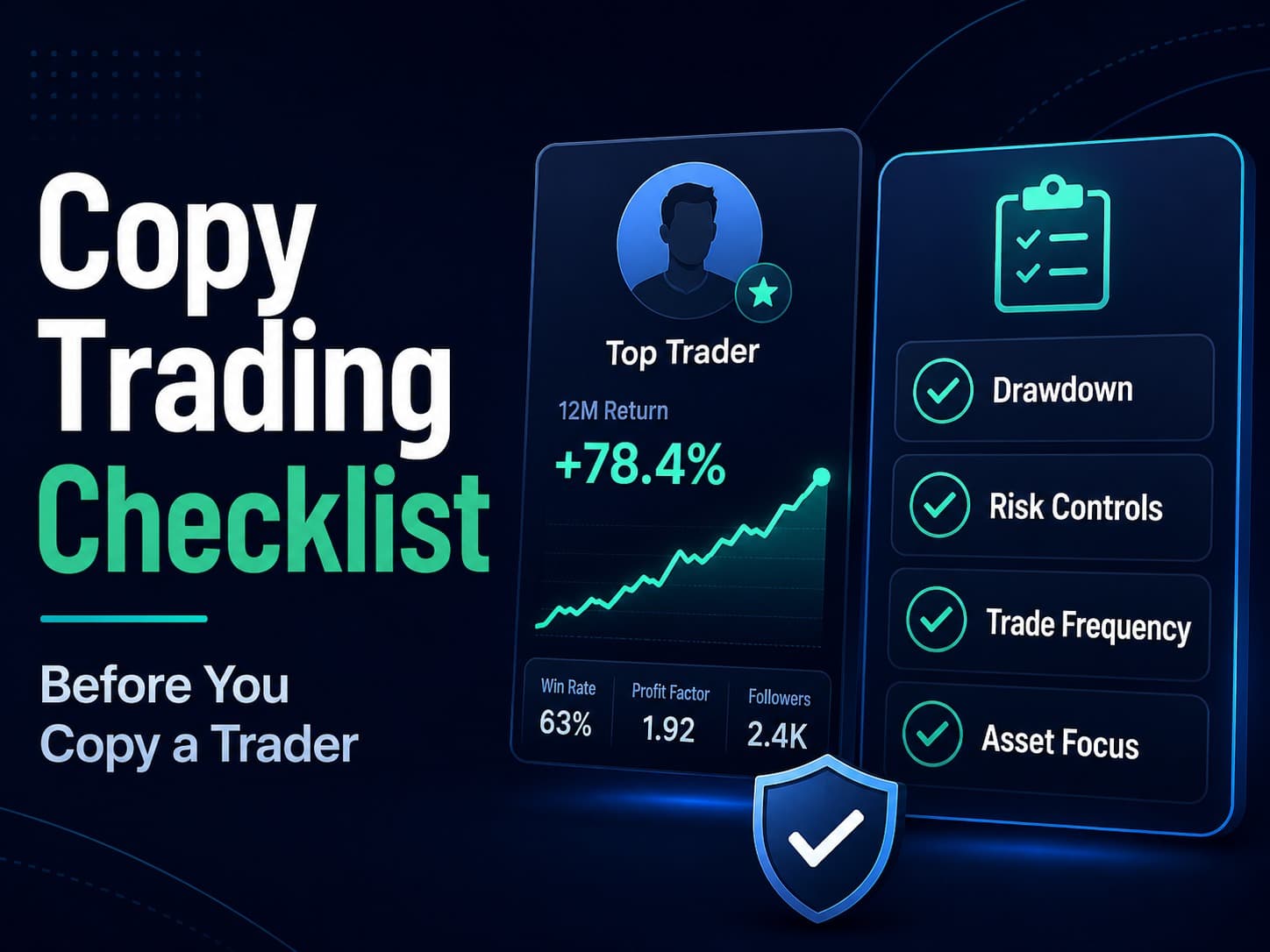
Copy Trading Checklist: Questions to Ask Before Copying a Trader
Copy trading can make market participation feel easier.
The user does not need to place every trade manually.
They do not need to watch every chart.
They do not need to react to every signal alone.
But that does not mean copy trading removes responsibility.
A copy trading checklist helps users slow down before copying a trader and understand the risk, behavior, and structure they may be delegating.
Before copying a trader, the real question is not only how much they returned, but what kind of structure the user is about to follow.
A trader’s returns may be visible first.
But returns do not explain everything.
They do not show how risk was taken.
They do not show how losses were handled.
They do not show how often trades were opened.
They do not show whether the trader’s behavior fits the user’s tolerance, goals, or time horizon.
This is why copy trading should begin with questions, not assumptions.
When users copy a trader, they are not only copying trades.
They are delegating a structure of decisions.
Why Copying a Trader Should Not Start With Returns
Most users notice returns first.
That is understandable.
Returns are simple.
Returns are visible.
Returns make traders easy to compare.
A trader with higher returns may look more attractive than a trader with lower returns.
But return is only the result.
It does not explain the process.
A trader may have produced strong returns through disciplined risk management.
Another trader may have produced strong returns through aggressive position sizing, concentrated exposure, frequent trading, or risk that may be difficult for the user to tolerate.
The return number can look similar.
The experience of copying the trader may be very different.
This is why users should slow down before copying a trader.
The question is not only:
Who made the most?
A better question is:
What am I actually copying?
This connects directly to questions every investor should ask before committing capital. Before capital follows a strategy, product, or trader, the user should understand what the structure may require over time.
Copy trading is no exception.
Direct Answer
What should users check before copying a trader?
Before copying a trader, users should check the trader’s trading style, drawdown, trade frequency, asset focus, risk controls, loss behavior, consistency, and whether the trader’s structure fits their tolerance, goals, and time horizon.
These questions do not guarantee better outcomes.
They do not remove risk.
They help users understand what kind of behavior, pressure, and structure they may be delegating.
What Are You Really Delegating When You Copy a Trader?
Copy trading is often described as following another trader.
That description is simple.
But it is incomplete.
When a user copies a trader, they may be delegating several things at once:
- Trade selection
- Timing
- Execution
- Position changes
- Risk behavior
- Reaction to market conditions
- Loss management
- Recovery behavior
This matters because delegation in investing does not remove responsibility.
It changes where responsibility sits.
The user may not be deciding every trade manually.
But the user is still responsible for choosing who to copy, how much to allocate, how often to review performance, and when the structure no longer fits.
Copy trading can reduce execution burden, but it does not remove the need for evaluation.
Before copying a trader, users should understand whether they are comfortable delegating that trader’s decision process.
Not just their past performance.
Questions About Trading Style
The first question is about trading style.
A trader’s style shapes the copying experience.
Some traders may trade frequently.
Some may hold positions longer.
Some may focus on short-term opportunities.
Some may use broader market themes.
Some may rely on specific assets or conditions.
Before copying a trader, users should ask:
- What is this trader’s general trading style?
- Does the trader trade short-term or longer-term?
- Does the trader follow trends, reversals, news, or technical setups?
- Is the style easy to understand?
- Has the style remained consistent over time?
- Would I be comfortable following this style during uncertain periods?
This is important because users may not emotionally experience all trading styles the same way.
A style that looks attractive during profitable periods may feel uncomfortable when conditions change.
A trader’s style should not only look impressive.
It should be understandable enough to evaluate.
Questions About Drawdown and Loss Behavior
Drawdown shows the part of the trader’s performance that return rankings often hide.
A trader may show strong returns.
But those returns may have included deep declines along the way.
Before copying a trader, users should ask:
- What was the trader’s maximum drawdown?
- How long did drawdowns last?
- How did the trader behave during losing periods?
- Did the trader reduce risk after losses?
- Did the trader increase risk after losses?
- Did the trader change strategy suddenly?
- How long did recovery take?
- Could I tolerate a similar drawdown in real time?
This matters because drawdown feels different when the user is actually copying the trader.
A loss that looks manageable on a historical chart may feel heavier when capital is exposed.
Drawdown is not only a metric.
It is part of the user’s lived experience.
A trader’s returns may be visible first, but their risk behavior is what the user may have to live with over time.
Questions About Trade Frequency
Trade frequency matters because copied trades still create an experience, even when the user is not placing them manually.
A high-frequency trader may open and close positions often.
That can create more visible account movement, more short-term volatility, and more emotional pressure.
A lower-frequency trader may create a different experience.
Before copying a trader, users should ask:
- How often does this trader open trades?
- Does the trader trade daily, weekly, or less frequently?
- Does trade frequency change during volatile conditions?
- Does frequent activity make the account harder to monitor calmly?
- Would I feel pressure watching many trades open and close?
- Does this frequency fit my available attention?
This point is important because copy trading does not always eliminate monitoring pressure.
The user may not execute the trades.
But the user may still feel the activity.
Trade frequency can change how copy trading feels over time.
Questions About Risk Controls
Risk controls matter most when the trader is under pressure, not only when performance looks strong.
Before copying a trader, users should ask:
- How does the trader manage position size?
- Does the trader use clear risk limits?
- Does risk increase after losses?
- Does the trader use concentrated exposure?
- Are losses managed in a consistent way?
- Is there evidence of overtrading after drawdowns?
- Does the trader’s risk behavior remain understandable?
Risk controls are important because performance can look strong during favorable market conditions.
But difficult periods reveal how a trader manages pressure.
A trader who performs well but takes risks the user cannot tolerate may not be a good fit.
A trader can be profitable and still be a poor fit for a user’s tolerance, time horizon, or expectations.
This is why copy trading performance beyond returns matters. Evaluation should include the structure behind performance, not only the outcome.
Questions About Asset Focus and Market Conditions
Copy trading decisions should also consider what the trader trades.
A trader focused on one asset or market may behave differently from a trader with broader exposure.
Before copying a trader, users should ask:
- What assets does the trader usually trade?
- Is the trader concentrated in one market?
- Does the trader depend on one type of market condition?
- Has the trader performed across different environments?
- What happens when the market changes?
- Does the trader’s asset focus create more volatility?
- Does this exposure fit my expectations?
Asset focus matters because markets do not behave the same way.
Some markets can move quickly.
Some can remain volatile for long periods.
Some can change direction suddenly.
Some may react strongly to news, liquidity, or macro conditions.
If a user does not understand the markets a trader focuses on, they may not understand the experience they are copying.
Copying a trader also means copying exposure to the trader’s preferred markets.
Questions About Fit With Your Tolerance and Time Horizon
A trader does not need to be bad to be a bad fit.
This is one of the most important points in copy trading.
A trader may be skilled.
A trader may be profitable.
A trader may have a clear process.
But the trader’s structure may still not fit the user.
Before copying a trader, users should ask:
- Can I tolerate the trader’s drawdown history?
- Does the trader’s frequency fit my attention level?
- Does the trader’s volatility fit my emotional tolerance?
- Does the trader’s time horizon match mine?
- Would I stay aligned during a losing period?
- Am I copying because I understand the trader, or because the returns look attractive?
- What would make me stop copying this trader?
These questions matter because copy trading is not only about the trader’s ability.
It is also about the user’s ability to remain aligned with the structure they choose.
A trader can be reasonable on paper and still be difficult to follow in practice.
That is why fit matters.
How SmartT Fits Into Copy Trading Oversight
SmartT becomes relevant when copy trading is treated as structured participation rather than blind following.
In this context, the user’s role shifts.
The user is no longer placing every trade manually.
But the user still needs to think about:
- Trader selection
- Capital allocation
- Risk awareness
- Monitoring
- Review discipline
- Alignment over time
SmartT can be understood as a platform environment where copy trading, automation, and risk-aware participation can be approached through structure.
This does not remove risk.
It does not remove responsibility.
It does not guarantee trader performance.
Instead, it changes the user’s role from constant execution to selection, allocation, oversight, and review.
For users exploring copy trading through SmartT, the important question is not simply which trader has the highest return.
It is which trader’s structure is understandable, observable, and aligned with the user’s tolerance.
A copy trading checklist becomes useful because it keeps the user focused on structure before action.
Copy Trading Checklist Before Following a Trader
Before copying a trader, users can use a practical checklist.
Ask Before Copying a Trader:
- What is this trader’s return history?
- How was that performance produced?
- What is the trader’s maximum drawdown?
- How long did recovery take after losses?
- How often does the trader trade?
- What assets or markets does the trader focus on?
- Does the trader use concentrated exposure?
- How does the trader manage position size?
- Does risk increase after losses?
- Does the trader change behavior under pressure?
- Is the trading style understandable?
- Has the style remained consistent?
- Does this trader fit my risk tolerance?
- Does this trader fit my time horizon?
- How often should I review this trader?
- What would make me stop copying?
This checklist does not make copy trading safe.
It makes the decision clearer.
The decision to copy a trader should happen before capital follows their trades.
Frequently Asked Questions
What questions should I ask before copying a trader?
A copy trading checklist should include the trader’s style, drawdown, trade frequency, asset focus, risk controls, loss behavior, consistency, and whether the trader’s structure fits your tolerance, goals, and time horizon.
Should I choose a trader based only on returns?
No. Returns show what happened, but they do not explain how those returns were produced. Users should also review risk behavior, drawdown, trade frequency, asset focus, and consistency.
Why does drawdown matter before copying a trader?
Drawdown matters because it shows how much decline occurred before recovery. It helps users understand the risk and emotional pressure they may experience while copying the trader.
How does trade frequency affect copy trading?
Trade frequency affects how active the copying experience may feel. Frequent trades can create more account movement, more monitoring pressure, and more short-term emotional reactions.
What does risk control mean in copy trading?
Risk control refers to how the trader manages position size, exposure, losses, drawdowns, and behavior under pressure. It matters because strong returns can hide aggressive risk-taking.
How do I know if a trader fits my tolerance?
A trader may fit your tolerance if their drawdown history, trade frequency, volatility, asset focus, and loss behavior are understandable and manageable for your goals, attention level, and time horizon.
Can SmartT help with copy trading oversight?
SmartT can support copy trading oversight by helping users approach trader selection, automation, allocation, monitoring, and risk-aware participation as part of a broader structure rather than blind following.
Closing Insight
Copy trading should not begin with assumptions.
It should begin with questions.
Not only:
Who returned the most?
But:
How was the return produced?
What risk was taken?
What behavior am I delegating?
What drawdown may I need to tolerate?
What markets will I be exposed to?
What would make this trader no longer fit?
When users copy a trader, they are not only copying trades.
They are choosing a structure to follow.
And that structure should be understood before capital follows it.
 Written by