Copy Trading Risk Management: What to Know Before Copying Traders
Copy trading can make trading feel more structured.
The user does not need to place every trade manually.
They may not need to follow every market movement manually.
They do not need to make every execution decision themselves.
But copy trading does not transfer all risk away from the user.
This is one of the most important ideas in copy trading risk management.
Many users assume that if a copied trader is responsible for trade decisions, then risk belongs mostly to the trader.
That is incomplete.
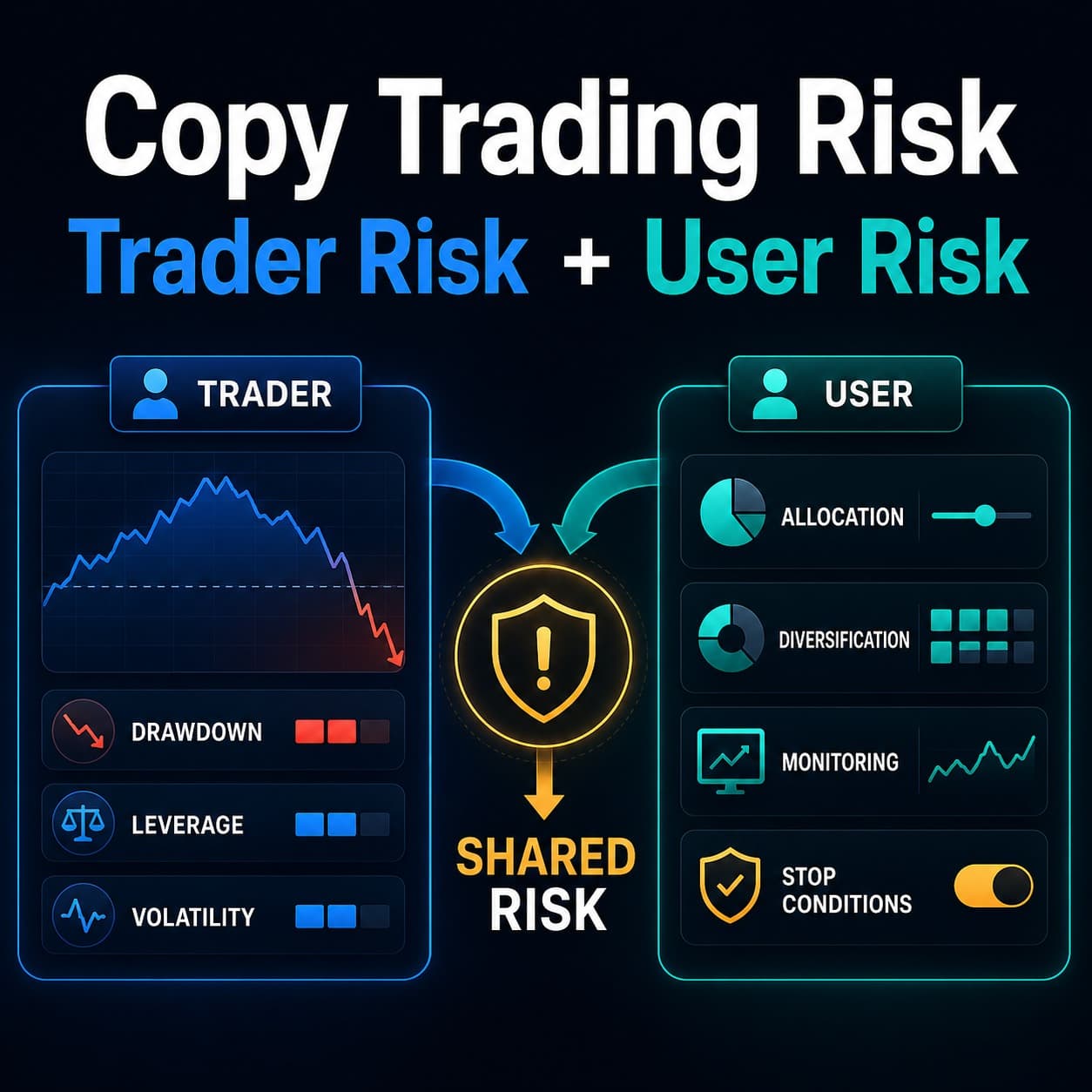
A copied trader may control trade decisions, but the user still controls allocation, tolerance, diversification, monitoring, and oversight.
Risk is not only inside the copied trader’s strategy.
Risk also comes from how the user copies.
How much exposure they accept.
How concentrated they become.
How much drawdown they can tolerate.
How often they review alignment.
When they reduce exposure or stop copying.
This is why copy trading risk management should not be treated as a single setting or a trader score.
It is a shared structure between the trader’s behavior and the user’s decisions.
Why Copy Trading Risk Management Matters
Copy trading often looks simple from the outside.
A user selects a trader.
The platform copies trades.
The user follows the results.
But the risk experience is not always simple.
A copied trader may have a visible performance history.
They may show returns, drawdown, win rate, or trade activity.
They may appear consistent during favorable periods.
But the user still has to decide how much capital to expose, how many traders to follow, how often to monitor performance, and what conditions would make them stop copying.
This matters because risk in copy trading is not only about whether the trader is skilled.
It is also about whether the user understands what they are exposing themselves to.
A trader can have strong historical performance and still create a risk experience that does not fit a user’s tolerance.
A trader can recover from drawdowns historically, but the user may still struggle to remain aligned during a live losing period.
A trader can trade frequently, use leverage, or focus on volatile markets in ways that feel very different when copied in real time.
This is why users should not treat copy trading as passive participation with no ongoing responsibility.
Copy trading can reduce execution burden.
It does not remove risk awareness.
Direct Answer
How should users manage risk in copy trading?
Copy trading risk management means understanding both trader-side risk and user-side risk. Users should review drawdown tolerance, allocation size, trader concentration, diversification, leverage exposure, monitoring frequency, and stop conditions before and after copying a trader.
This does not guarantee better outcomes.
It does not make copy trading safe.
It helps users make risk more visible before it becomes emotional.
Why Copy Trading Risk Is Shared Between Trader and User
Risk in copy trading is shared because copied trades are executed from another trader’s decisions, but the user still chooses how to participate.
The trader may decide:
- What to trade
- When to enter
- When to exit
- How often to trade
- How to size positions
- How to respond to losses
But the user decides:
- Whether to copy the trader
- How much capital to allocate
- Whether to copy one trader or several
- How much volatility they can tolerate
- How often to review performance
- When to reduce or stop exposure
This is why copy trading risk management is not only about finding a “low-risk trader.”
A trader’s behavior matters.
But the user’s structure matters too.
Risk in copy trading is not only about who trades. It is also about how the user allocates, monitors, and responds.
This is also why risk profile labels often mislead investors. A label such as conservative, balanced, or aggressive may sound simple, but the real experience depends on structure, exposure, behavior, and the user’s ability to stay aligned.
Copy trading risk should be understood through both sides.
The trader side.
And the user side.
Trader-Side Risk vs User-Side Risk
A useful way to understand copy trading risk is to separate trader-side risk from user-side risk.
Trader-side risk comes from the behavior of the copied trader.
This may include:
- Trading style
- Position sizing
- Drawdown behavior
- Leverage exposure
- Recovery behavior
- Asset selection
- Trade frequency
- Loss management
These are risks inside the trader’s strategy or behavior.
The user does not directly control these decisions once copying begins.
But the user does control whether that trader is copied and how much exposure is assigned.
User-side risk comes from how the user copies.
This may include:
- How much capital is allocated
- Whether exposure is concentrated in one trader
- Whether multiple traders share similar behavior
- Whether the user understands drawdown
- Whether the user reviews performance regularly
- Whether the user has stop or review conditions
- Whether emotional reactions lead to sudden changes
This distinction matters.
A trader may be risky because of how they trade.
A user may increase risk further by allocating too much, copying too many similar traders, ignoring drawdowns, or failing to monitor changes.
Copy trading risk management should address both.
Not only the trader.
Not only the user.
The full structure.
Allocation Risk: How Much Exposure You Choose to Accept
Allocation risk is one of the most important parts of copy trading risk management.
When users copy a trader, they also choose how much exposure to accept.
This does not mean there is one correct allocation for everyone.
There is not.
A suitable allocation depends on the user’s capital, tolerance, goals, experience, and ability to handle drawdown.
But the principle is simple:
The more capital a user allocates to one trader, the more that trader’s behavior affects the user’s account experience.
A small allocation may make a trader’s volatility easier to tolerate.
A large allocation may make the same trader feel much more stressful.
This is why allocation should not be based only on return history.
Users should ask:
- How much of my account would be affected by this trader?
- Can I tolerate the trader’s historical drawdown at this allocation level?
- What happens if the trader enters a losing period?
- Am I allocating because I understand the structure or because the returns look attractive?
- Would I make the same decision during a difficult market period?
Allocation risk is user-side risk.
The trader does not decide how much of the user’s capital is exposed.
The user does.
Drawdown Tolerance: What You Can Actually Withstand
Drawdown is often discussed as a trader metric.
But in copy trading, drawdown is also a user test.
Drawdown is not just a trader metric. It is a test of whether the user can stay aligned with the structure they selected.
A trader may have recovered from past drawdowns.
But that does not mean every user can emotionally or financially tolerate the same experience.
This is especially important because drawdowns feel different in real time.
On a performance chart, drawdown is historical information.
In a live account, drawdown can create uncertainty, doubt, and pressure.
Users may wonder:
- Is the trader still following the same process?
- Is the strategy no longer working?
- Should I stop copying now?
- Should I wait for recovery?
- Did I allocate too much?
This is why drawdown tolerance should be considered before copying begins.
Users should ask:
- What drawdown has this trader experienced before?
- How long did recovery take?
- Would I tolerate a similar decline?
- Would I still trust the structure during a losing period?
- Would this drawdown affect my decision-making?
- Did I allocate an amount that makes drawdown emotionally manageable?
Copy trading risk management is not only about avoiding drawdown.
Drawdowns can happen.
The goal is to understand whether the user can tolerate the structure they are choosing.
Trader Concentration and Diversification
Trader concentration happens when too much exposure depends on one trader or one behavior pattern.
This can happen even when a user copies more than one trader.
For example, a user may copy several traders, but if all of them trade the same asset, use similar timing, or react to the same market conditions, the user may still be concentrated.
Diversification in copy trading should not mean copying many traders blindly.
It should mean reducing dependence on one behavior pattern.
This matters because copying multiple traders can create the appearance of diversification without actually reducing risk.
Users should ask:
- Am I relying too much on one trader?
- Do the traders I copy behave differently?
- Do they trade different markets or timeframes?
- Do they react differently during volatility?
- Am I increasing diversification or just adding more exposure?
- Could several copied traders lose at the same time under similar conditions?
Diversification should be intentional.
It should not be a reaction to wanting more activity or more return opportunities.
In copy trading, more traders do not automatically mean better risk management.
Sometimes more traders simply mean more complexity.
Leverage Exposure and Position Sizing
Leverage can make copied trades feel very different from the performance chart that attracted the user.
This is a sensitive part of copy trading risk management because leverage can increase both opportunity and risk exposure.
The key point is not to encourage leverage.
The key point is to understand how leverage exposure can affect the user’s real experience.
A trader’s performance may look attractive historically.
But if that performance involved aggressive exposure, large position sizing, or leveraged market conditions, the user needs to understand what that may mean in practice.
Users should ask:
- Does the trader use leveraged instruments?
- How large are positions relative to account size?
- Does position sizing increase after losses?
- Does the trader use concentrated exposure?
- Could leverage make drawdowns sharper?
- Would the same strategy feel acceptable in my own account?
Position sizing matters because it shapes how quickly losses or gains can affect the account.
Leverage exposure matters because it can increase the gap between what the user expects and what the user experiences.
This is why copy trading performance should never be evaluated only through return.
It should also be evaluated through risk exposure.
This connects directly to copy trading performance beyond returns, where drawdown, trade frequency, risk exposure, and recovery behavior help explain how performance was produced.
Monitoring Frequency and Ongoing Oversight
Risk management is not a one-time setting.
It is an ongoing review process.
A user may carefully choose a trader at the beginning.
But market conditions can change.
Trader behavior can change.
Drawdown patterns can change.
Trade frequency can change.
Risk exposure can change.
This is why copy trading still requires oversight.
The user does not need to monitor every trade constantly.
But they should have a reasonable review process.
Users should ask:
- How often should I review this trader?
- Has the trader’s behavior changed?
- Is drawdown still within a range I expected?
- Is trade frequency still aligned with what I understood?
- Has risk exposure increased?
- Is the trader still a fit for my tolerance?
- Am I reacting emotionally or reviewing structurally?
Monitoring should not mean panic-checking every movement.
It should mean reviewing whether the structure still matches the user’s expectations.
This is where delegation in investing becomes important. Delegation can reduce daily decision pressure, but it does not remove the need to review what has been delegated.
Copy trading is delegated execution.
Not delegated responsibility.
Stop Conditions: When to Review or Stop Copying
Stop conditions should be considered before emotional pressure appears.
Many users only think about stopping after losses begin.
That can make the decision emotional.
A better approach is to define review conditions before copying starts.
Stop conditions do not need to mean automatic exit after one loss.
They can be structured review points.
For example, a user may decide to review a copied trader if:
- Drawdown exceeds an expected range
- Trade frequency changes significantly
- Position sizing becomes more aggressive
- The trader changes asset focus
- Recovery behavior becomes unclear
- Risk increases after losses
- The trader no longer fits the user’s tolerance
- The user no longer understands the structure
The goal is not to react to every negative movement.
The goal is to avoid having no plan when pressure appears.
A good copy trading decision includes knowing when not to copy, when to reduce exposure, and when to review alignment.
This also connects to the idea of a copy trading checklist. Before copying a trader, users should understand what they are copying and what conditions would make that decision worth reviewing.
How SmartT Supports Risk-Aware Participation
SmartT should be understood through the lens of risk-aware participation.
It should not be understood as a tool that removes risk.
It should not be treated as a guarantee of outcomes.
And it should not replace user responsibility.
SmartT becomes relevant when copy trading is approached as structured, risk-aware participation rather than blind delegation.
In a structured copy trading environment, the user’s role shifts from manual execution to:
- Trader selection
- Allocation awareness
- Risk review
- Monitoring
- Oversight
- Alignment checks
This is why structured copy trading platforms should not be judged only by automation.
They should also help users think more clearly about trader selection, allocation, and oversight.
SmartT can support this kind of approach by helping users think about copy trading through trader selection, allocation awareness, automation, and ongoing oversight.
But the user still needs to understand risk.
The user still needs to make allocation decisions carefully.
The user still needs to monitor whether copied traders remain aligned with their tolerance.
The goal is not to remove risk.
The goal is to make risk visible before it becomes emotional.
Copy Trading Risk Management Checklist
Before and after copying a trader, users can review risk through a practical checklist.
Ask Before and After Copying a Trader:
- What type of risk does this trader take?
- How much drawdown has the trader experienced?
- Can I tolerate a similar drawdown?
- How much exposure am I choosing to accept?
- Am I too concentrated in one trader?
- Do copied traders behave differently or similarly?
- Does the trader use leverage or aggressive position sizing?
- Does risk increase after losses?
- How often should I review this trader?
- What changes would trigger a review?
- What would make me reduce exposure?
- What would make me stop copying?
- Am I making this decision based on structure or returns alone?
- Does this trader still fit my tolerance and time horizon?
This checklist does not remove risk.
It helps users see risk more clearly.
Risk management in copy trading is not about finding a risk-free trader.
It is about understanding the structure before, during, and after copying.
Frequently Asked Questions
What is copy trading risk management?
Copy trading risk management means reviewing both trader-side risk and user-side risk, including drawdown tolerance, allocation size, trader concentration, diversification, leverage exposure, monitoring frequency, and stop conditions.
Is copy trading risk only the trader’s responsibility?
No. The copied trader controls trade decisions, but the user still controls allocation, exposure, diversification, monitoring, and whether the trader remains suitable over time.
How should users think about allocation in copy trading?
Users should think about allocation as exposure. The more capital assigned to one copied trader, the more that trader’s behavior affects the user’s account experience. Allocation should be considered in relation to the user’s tolerance, goals, and ability to handle drawdown.
Why does drawdown tolerance matter in copy trading?
Drawdown tolerance matters because losses feel different when they happen in real time. A trader may have recovered from drawdowns historically, but the user still needs to tolerate the same experience while capital is exposed.
Should I copy multiple traders or one trader?
Copying multiple traders can reduce dependence on one trader, but only if the traders behave differently. Copying many traders with similar strategies, assets, or risk behavior may still create concentrated exposure.
How often should I monitor copied traders?
Users should monitor copied traders often enough to confirm that behavior, drawdown, frequency, and risk exposure remain aligned with expectations. Monitoring should be structured review, not emotional reaction to every trade.
Can SmartT remove copy trading risk?
No. SmartT does not remove copy trading risk or guarantee outcomes. It can support a more structured approach to trader selection, automation, allocation awareness, and oversight, but users remain responsible for understanding and monitoring risk.
Closing Insight
Copy trading risk management starts with a simple idea:
Risk is shared.
The trader controls trade behavior.
The user controls participation structure.
That means risk is shaped by both sides.
The trader’s decisions matter.
The user’s allocation matters.
The trader’s drawdown matters.
The user’s tolerance matters.
The trader’s exposure matters.
The user’s oversight matters.
Copy trading does not transfer all risk away from the user.
It changes how risk is experienced.
A copied trader may control trades, but the user still chooses how much to allocate, how concentrated to become, how often to review, and when to stop or reduce exposure.
The goal is not to remove risk.
The goal is to understand risk before it becomes emotional.
That is what makes copy trading risk management a structure, not a checkbox.
 Written by