Decision Fatigue in Investing: The Hidden Risk Nobody Models
Most investment breakdowns do not begin with losses. They begin with depletion. At first, active decision-making can feel engaging. Monitoring markets, interpreting signals, evaluating new information - these actions often create a sense of control and responsibility.
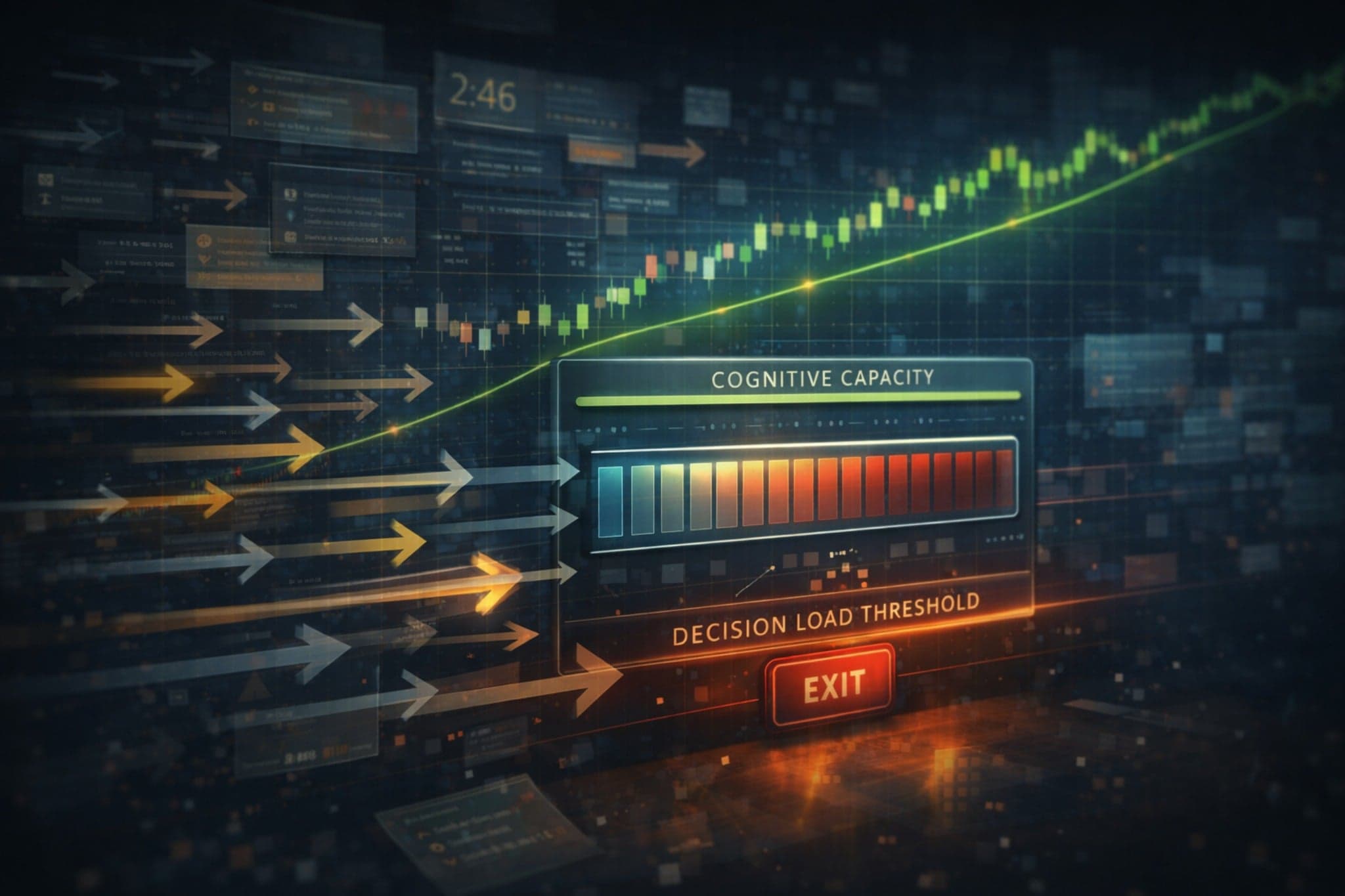
Over time, a structural tension emerges. Decision fatigue in investing is a structural behavioral risk that emerges when decision frequency exceeds sustainable cognitive capacity. Investor breakdown is rarely a failure of conviction; it is often a failure of sustainable cognitive architecture.
Frequent investment decisions consume cognitive bandwidth long before capital is affected.
The strain rarely appears dramatic. It accumulates through repeated micro-judgments: Adjust or hold? Rebalance now or later? React to volatility or ignore it? Trust the framework or reconsider it?
Individually, each decision seems manageable. Collectively, they create friction - not as panic, but as fatigue. Decision fatigue in investing operates less as episodic stress and more as a cumulative structural burden.
Educational Notice: This page is intended for informational and educational purposes only. It does not provide financial, investment, or legal advice, nor does it recommend specific assets, predict performance, or guarantee outcomes. All investments involve risk, including potential loss of capital. Readers should consider their own circumstances and seek independent professional guidance where appropriate.
What Is Decision Fatigue in Investing?
The breakdown rarely stems from misunderstanding the strategy. It emerges from cognitive depletion. Under sustained decision pressure, investors often experience:
- Reduced patience
- Heightened second-guessing
- Shortened time horizons
- Increased sensitivity to noise
The mechanism can be traced as a structural chain: Decision frequency → cumulative cognitive load → declining self-regulation efficiency → shortened evaluative horizon → rising abandonment probability - even when the strategy remains logically intact.
The failure mode is not a collapse of logic, but a collapse of endurance.
Behavioral research on bounded rationality documents limits of sustained cognitive effort. Under repeated evaluation and interpretive pressure, individuals do not merely become less precise - they become less willing to continue exerting regulatory effort.
In financial contexts, this manifests as gradual erosion of self-regulation capacity within investment decision-making psychology. A strategy can remain coherent while the investor’s ability to continuously re-endorse it deteriorates.
High returns don’t guarantee good decisions. What really shapes long-term results is how risk compounds, how fees erode capital, and how volatility tests your discipline. Before you choose an investment based on performance alone, make sure you're evaluating the hidden factors that determine what you actually keep.
Stop Comparing Returns - Use This Framework Instead →How Decision Frequency Creates Behavioral Risk
Traditional risk models account for volatility, liquidity, and drawdowns. They rarely account for decision frequency. Yet decision frequency functions as structural friction - a behavioral risk embedded in portfolio architecture.
From a structural standpoint, decision frequency operates as a design parameter. The higher the required rate of discretionary judgment, the greater the cumulative cognitive load imposed on the investor. Behavioral capacity therefore becomes a constraint variable alongside capital, liquidity, and formal risk tolerance.
Two diagnostic concepts clarify this dynamic:
Decision Load Threshold: the point at which repeated discretionary judgment begins to degrade decision quality.
Endurance Gap: the widening gap between a structure’s required decision load and an investor’s sustainable behavioral bandwidth.
While the Decision Load Threshold is conceptual, it is not purely abstract. It often becomes visible through subtle behavioral shifts: compression in time-to-decision, increasing discretionary overrides of predefined rules, and subjective signals of cognitive fatigue during otherwise routine evaluations.
These indicators rarely present as dramatic events. They accumulate quietly before structural abandonment occurs. The larger the Endurance Gap, the more fragile discipline becomes - independent of market outcomes.
Fragility here does not imply irrationality; it reflects structural misalignment between demand and capacity.
High-frequency decision environments tend to amplify perceived urgency. Sustained urgency increases cognitive wear, gradually compressing patience and widening the Endurance Gap.
When decision load persistently exceeds cognitive bandwidth, disengagement tends to rise because the binding constraint becomes behavioral rather than financial. Decision frequency is not merely a feature of strategy design. It is a behavioral sustainability variable.
The implication is not that lower decision frequency is inherently superior, but that alignment between structural demand and behavioral capacity largely determines sustainability. This framework does not evaluate performance, compare strategies, or prescribe structure. It isolates one under-modeled variable: the endurance required to continuously decide.
Why Investors Abandon Strategies Due to Decision Fatigue
When investors step away from a strategy, they often interpret the decision as:
- A lapse in discipline
- Emotional weakness
- Impatience
Decision fatigue reframes the experience. The issue is frequently structural intensity rather than personal instability. A structure that requires constant judgment increases:
- Cognitive load
- Self-doubt cycles
- Interpretive stress
Even experienced investors can experience depletion under sustained cognitive demand. The more accurate question shifts from blame to structure:
From “Why did I fail?” to “What was this structure asking me to sustain - and for how long?”
That shift clarifies the structural causes of investor abandonment without dissolving the tension it exposes.
What Happens When Decision Fatigue Compounds?
Decision fatigue rarely exists in isolation. It often connects to:
- Information overload
- High feedback speed
- Concentrated responsibility
- Transparency pressure
Each layer compounds cognitive strain, widening the Endurance Gap. Decision fatigue in investing is not merely a psychological curiosity. It often signals that structural demands are exceeding behavioral capacity.
When that misalignment persists, breakdown tends to follow - not because logic disappeared, but because sustained judgment became progressively more costly to maintain.
Frequently Asked Questions (FAQ)
1. What is decision fatigue in investing?
Decision fatigue in investing refers to the gradual deterioration of judgment quality after repeated investment decisions. When decision frequency exceeds sustainable cognitive capacity, investors may experience reduced patience, increased second-guessing, and higher likelihood of strategy abandonment - even if the underlying strategy remains sound.
2. Why do investors abandon strategies even when they are working?
Investors often abandon strategies not because of poor performance, but because of accumulated behavioral strain. Frequent decision-making, volatility exposure, and ongoing interpretation demands can widen the Endurance Gap - making the experience difficult to sustain over time.
3. How does decision frequency create behavioral risk?
Higher decision frequency increases cognitive load and self-regulation demands. Over time, repeated discretionary decisions can degrade judgment efficiency, shorten evaluation horizons, and raise abandonment probability - independent of market outcomes.
4. What is the Decision Load Threshold?
The Decision Load Threshold is the point at which repeated discretionary judgment begins to reduce decision quality. It often becomes visible through subtle behavioral signals such as faster reaction times, rule overrides, and cognitive fatigue during routine evaluations.
5. What is the Endurance Gap in investing?
The Endurance Gap describes the widening gap between a strategy’s required decision load and an investor’s sustainable behavioral capacity. When this gap expands, discipline becomes fragile - increasing the risk of disengagement even without structural flaws in the strategy.
6. Is decision fatigue a sign of weak discipline?
Not necessarily. Decision fatigue often reflects structural misalignment rather than personal weakness. When a strategy demands sustained discretionary judgment, even experienced investors can experience cognitive depletion over time.
7. Can decision fatigue affect long-term investment outcomes?
While this framework does not predict performance, decision fatigue can influence whether investors remain committed long enough for long-term outcomes to materialize. Behavioral sustainability often determines whether theoretical returns are captured in practice.
 Written by