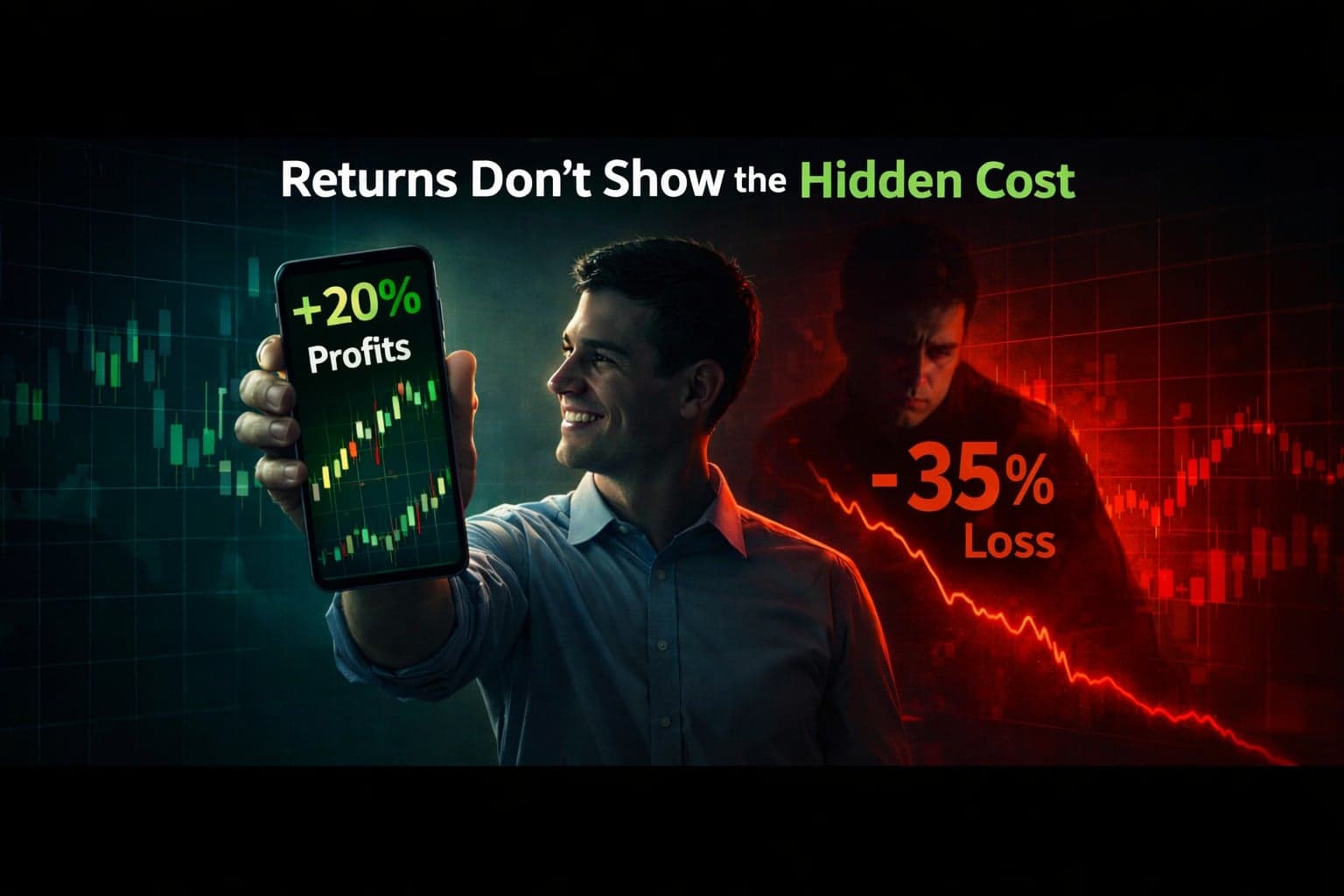
If You’re Only Comparing Returns, You’re Missing the Real Cost of Investing
Why Most Investment Conversations Start and End-in the Wrong Place
Most investment conversations begin with a single, familiar question:
How much does it return?
This page exists to help investors compare investment strategies beyond headline returns,
by examining investment structure and the behavioral costs
these strategies impose over time and uncertainty - not by ranking assets or predicting
future performance.
Important Context
This page is intended for informational and educational purposes only.
It does not provide financial, investment, or legal advice, nor does it recommend specific assets,
predict performance, or guarantee outcomes. All investments involve risk, including potential loss of capital.
Readers should consider their own circumstances and seek independent professional guidance where appropriate.
Why “How Much Does It Return?” Feels Like the Right Question
This question dominates financial media, marketing materials, social platforms, and even professional advisory discussions.
It feels objective. It feels rational. And perhaps most importantly, it feels safe - a numerical anchor in a field defined by uncertainty.
Returns are easy to communicate.
They fit neatly into charts, tables, performance summaries, and historical comparisons.
They create the illusion of clarity in a domain that is otherwise complex, probabilistic, and deeply human.
From a surface-level perspective, this focus makes sense. Investors want growth. Advisors want benchmarks. Institutions want comparability.
But this convenience hides a deeper -and more consequential- problem.
Over time, an excessive focus on returns encourages investors to compare outcomes without understanding the structures that produce them.
It pushes decision-making toward simplified metrics while quietly ignoring the lived realities that determine whether an investment can actually be held, managed, and sustained.
What This Page Helps You Compare - Beyond Returns
This page examines investment strategies through the structural and
behavioral costs investors actually live with over time.
Rather than ranking assets, promoting strategies, or forecasting performance,
it reframes comparison around how an investment functions in practice - especially
during periods of uncertainty, stress, and imperfect decision-making.
The comparison is organized around the following structural dimensions:
-
Strategy Structure & Liquidity Constraints
How capital is committed, accessed, or restricted across normal conditions
and periods of stress.
-
Time Horizon Alignment
How a strategy’s implicit timelines interact with real-world cash flow needs,
patience limits, and evaluation habits.
-
Volatility Exposure vs. Behavioral Tolerance
Whether an investor can realistically remain invested through drawdowns -
not in theory, but in lived experience.
-
Decision Pressure & Execution Risk
The psychological strain created by discretion, timing, and repeated
decision points under uncertainty.
-
Complexity & Ongoing Management Burden
The cognitive and operational cost of monitoring, interpreting,
and maintaining the strategy over time.
-
Fragility Under Stress
How strategies behave when assumptions break, correlations shift,
or market conditions diverge from expectations.
Each of these dimensions shapes investor behavior long before returns are realized -
and often determines whether returns can be captured at all.
This page is designed to surface those trade-offs clearly, so investment choices
can be evaluated not just by outcomes, but by their sustainability in real life.
The Hidden Risk of Return-First Investing
Ironically, return-focused investing carries a risk that often goes unnoticed.
Not an immediate or emotional reaction - but a slower, more consequential realization:
The realization that years later, an investor may discover they chose an investment that never truly fit the life they were living.
Many investors don’t struggle because they selected the wrong asset.
They struggle because they optimized for returns while underestimating:
- The emotional cost of volatility
- The mental load of constant decision-making
- The pressure of responsibility when control is high
- The stress of uncertainty when timelines are unclear
By the time this realization surfaces, the cost is no longer theoretical. It is reflected in lost time, abandoned strategies, and long-term dissatisfaction.
Poor structural decisions don’t just affect portfolios-they shape behavior, decision quality, and long-term financial stability.
The Questions Investment Returns Never Answer (But Always Imply)
What Does This Investment Require From the Investor - In Reality?
Not in theory.
Not in backtests.
But during drawdowns, stagnation, and uncertainty.
Does it require constant engagement? Rapid reactions? Emotional detachment under pressure?
How Much Time, Attention, and Cognitive Energy Does It Demand?
Is this an investment that tolerates neglect - or one that punishes inattention?
Does it require:
- Daily monitoring?
- Weekly decisions?
- Or multi-year patience with minimal action?
Time and mental bandwidth are finite resources. Ignoring this cost is one of the most common structural mistakes investors make.
How Much Uncertainty Must Be Endured - and For How Long?
Some investments demand comfort with long periods of ambiguity.
Others require quick feedback loops and frequent evaluation.
The psychological cost of uncertainty varies dramatically between individuals - and mismatches here often lead to premature exits.
How Much Control - and Responsibility - Does the Investor Actually Carry?
Control is often presented as safety.
In reality, control increases responsibility.
What happens psychologically when:
- Decisions must be made without clear signals?
- Control fails to prevent losses?
- Responsibility becomes emotionally overwhelming?
These questions are harder to quantify, which is precisely why they are often ignored.
Yet they determine whether an investment strategy is followed consistently -or abandoned under pressure.
Performance on Paper vs. Investing in Real Life
In theory, many investment strategies look remarkably similar.
They may:
- Share comparable long-term return expectations
- Appear equally attractive in historical performance data
- Be grouped under the same “risk profile” or asset class
On paper, they seem interchangeable.
In practice, they are not.
The Structural Reality Gap Between Investment Strategies
One investment may demand:
- Continuous monitoring and frequent evaluation
- Emotional resilience through volatility and extended drawdowns
- Repeated judgment calls under uncertainty, often with incomplete information
Another investment, with similar headline returns, may:
- Require minimal ongoing intervention once properly positioned
- Operate within clearly defined boundaries and constraints
- Allow the investor to remain psychologically detached from short-term fluctuations
The difference between these experiences is not reflected in annualized returns or backtests.
It shows up elsewhere - quietly and persistently:
- Fatigue
- Anxiety
- Second-guessing
- Decision paralysis
Over time, these factors shape behavior far more powerfully than expected returns ever do.
Why Investors Abandon Strategies That Look Good on Paper
Investors rarely quit because of poor performance alone.
They quit because the experience becomes intolerable.
A strategy may be:
- Statistically sound
- Historically validated
- Theoretically optimal
And still fail in real life because it demands more emotional discipline, time, or attention than the investor can realistically provide.
The Trade-Off Between Perceived Advantage and Hidden Burden
The Perceived Advantages of High-Return Narratives
- Clear performance targets
- Easier comparison across options
- Strong performance storytelling
The Hidden Costs Investors Often Ignore
- Increased stress during volatility
- Higher likelihood of emotional decision-making
- Greater abandonment risk during drawdowns
This is not a judgment - it is a structural trade-off. Ignoring it turns “high potential” into high friction.
The Real Cost Behind Similar Investment Returns
Two investments can generate similar numbers - and still extract very different prices from the investor.
One may extract:
- Time and constant engagement
- Cognitive bandwidth and mental energy
- Emotional discipline during repeated uncertainty
The other may extract:
- Patience over long periods of inactivity
- Acceptance of limited control
- Trust in structure rather than constant action
Neither cost is inherently superior or inferior.
The risk emerges when the cost is mispriced - when an investor commits to an investment structure without fully understanding what it will demand during difficult periods.
This misunderstanding often leads to predictable outcomes:
- Premature exits during drawdowns
- Overreaction to short-term noise
- Strategy-hopping driven by stress rather than logic
Over long horizons, these behaviors quietly destroy results - not because the investments were flawed, but because the investor was placed in a structure they could not realistically sustain.
Why Investment Structure Matters More Than Most Investors Think
Key Insight:
Ignoring how an investment functions in real life - not just how it performs on paper - is one of the most common sources of long-term dissatisfaction and underperformance in investing.
Structure shapes behavior.
Behavior shapes outcomes.
Returns are the result of that chain - not the starting point.
Why Returns Alone Are a Dangerous Comparison Tool
Returns are outcomes.
They are not processes.
Comparing investments based only on returns is similar to comparing careers solely on income - without considering hours worked, stress levels, autonomy, or long-term sustainability.
The number may look appealing - but it tells you nothing about:
- The pressure required to maintain it
- The volatility endured along the way
- The likelihood of staying committed during prolonged adversity
Misaligned financial decisions can carry long-term consequences that extend far beyond short-term market performance.
What This Investment Framework Is - and Is Not-Designed to Do for Investors
This article introduces a practical investment comparison framework designed to shift the conversation from performance to structure.
What the Framework Helps Investors Understand
- What an investment is actually built to do
- What it demands during difficult periods
- How it behaves across time, stress, and uncertainty
What This Framework Does Not Attempt
- Rank investments from best to worst
- Predict future performance
- Recommend specific assets or strategies
- Eliminate risk or uncertainty
Markets remain uncertain. Outcomes will always vary. What this framework provides is clarity - clarity about trade-offs that are often hidden until they become costly.
The Question Most Investors Ask Too Late
Most investors eventually reach a realization - often after years of experience, frustration, or repeated course changes.
The problem was not the investment itself.
The problem was misalignment.
Misalignment between:
- Capital commitment and emotional tolerance
- Risk exposure and behavioral capacity
- Control and responsibility
- Strategy demands and real-life constraints
These mismatches rarely reveal themselves early. They emerge gradually - through stress, avoidance, impulsive decisions, or persistent dissatisfaction.
By the time the issue becomes obvious, valuable time has already been lost.
This framework exists to surface those mismatches before they compound.
Who This Investment Framework Is For - and Who It Is Not
Who This Framework Is Designed For
This framework is for investors who want to understand investment structure, not just outcomes.
It is for those who care about alignment:
- Between capital and time horizon
- Between strategy design and human psychology
- Between financial ambition and everyday reality
These investors are not seeking certainty.
They are seeking informed, responsible choice.
Who This Framework Is Not Designed For
This framework is not intended for:
- Those seeking guaranteed or effortless returns
- Short-term speculation driven by urgency or hype
- Anyone unwilling to accept that meaningful investing always involves trade-offs
If certainty is the primary objective, this framework may feel restrictive - or even uncomfortable.
That limitation is intentional.
The Full Investment Comparison Framework
Once the limits of return-based thinking become clear, a natural question emerges:
If returns are not enough, what should investors compare instead?
Answering this question requires moving beyond outcomes and into structure - examining how an investment
is designed to function across time, uncertainty, and human behavior.
This framework does not attempt to simplify investing into a single score or ranking.
Instead, it offers a way to evaluate investments based on the realities investors must live with—not just the results they hope to achieve.
Why Comparing Structures Matters More Than Comparing Assets
Most investment comparisons focus on what is being invested in: stocks vs. bonds, active vs. passive, public vs. private.
This framework focuses on how an investment behaves once it is held.
Two investments in the same asset class can impose radically different demands on the investor - while two investments
in different asset classes can feel structurally similar in practice.
Structure, not asset label, determines:
- How decisions are made
- How stress is experienced
- How mistakes compound
- How long an investor can realistically stay invested
Understanding structure is what allows investors to compare investments meaningfully - before experience turns theoretical trade-offs into lived consequences.
The Core Dimensions of Investment Structure
Every investment - regardless of asset type - can be analyzed through a small set of structural dimensions.
These dimensions are always present. What differs is how intensely each one is expressed.
Decision Frequency and Intervention Demand
How Often Must the Investor Act?
Some investments require frequent judgment calls: rebalancing, timing, tactical adjustments, or ongoing evaluation.
Others are designed to operate with minimal intervention once established.
The difference is not trivial.
High decision frequency increases:
- Cognitive load
- Emotional fatigue
- The probability of behavioral errors
Low decision frequency shifts the burden toward patience and trust in process.
Neither is inherently better - but each carries a distinct psychological cost that must be matched to the investor’s capacity.
Volatility Experience vs. Volatility Statistics
How Losses Are Felt, Not Just Measured
Volatility is often discussed as a number. In practice, it is an experience.
Two investments with similar drawdown statistics can feel entirely different depending on:
- Speed of losses
- Visibility of price movements
- Clarity of recovery expectations
Some structures expose investors to constant feedback and visible fluctuations.
Others compress uncertainty into longer periods of silence and delayed resolution.
The human response to volatility is shaped less by magnitude than by how it is encountered.
Time Horizon Alignment
When Feedback Arrives - and When It Doesn’t
Every investment implies a timeline for evaluation.
Some provide rapid feedback, inviting frequent reassessment.
Others delay meaningful signals for years.
Misalignment occurs when:
- Short-term evaluators commit to long-horizon structures
- Long-term investors place capital in feedback-heavy environments
The resulting tension often leads to premature exits - not because the investment failed, but because the timeline conflicted with the investor’s psychological expectations.
Control and Responsibility Distribution
Who Carries the Burden of Decision-Making?
Control is frequently marketed as empowerment. Structurally, it also transfers responsibility.
High-control investments require:
- Ongoing judgment under uncertainty
- Acceptance of personal accountability for outcomes
- Emotional resilience when decisions fail to deliver results
Lower-control structures shift responsibility toward predefined rules, constraints, or external managers - but demand trust and tolerance for limited intervention.
The critical question is not “How much control is ideal?” It is “How much responsibility can the investor sustainably carry?”
Transparency and Cognitive Load
How Much Must Be Understood to Stay Invested?
Some investments demand continuous interpretation: macroeconomic narratives, positioning logic, scenario analysis.
Others are intentionally opaque, offering limited information but clearer boundaries.
Transparency reduces ambiguity - but increases mental engagement.
Opacity reduces decision pressure - but can amplify uncertainty during stress.
Investors often underestimate how exhausting constant interpretation can become over long horizons.
Behavioral Failure Modes Embedded in Structure
Every structure has predictable failure points.
High-engagement strategies tend to fail through:
- Overreaction
- Excessive tinkering
- Short-term noise chasing
Low-engagement strategies tend to fail through:
- Loss of conviction
- Impatience
- Abandonment during extended inactivity
The framework does not eliminate these risks. It makes them visible - so they can be chosen consciously rather than discovered painfully.
Why This Framework Avoids Rankings and Scores
It may be tempting to collapse these dimensions into a single rating or hierarchy.
This framework deliberately avoids doing so.
Why? Because optimization without context creates false precision.
An investment that ranks “better” on paper may be structurally incompatible with the investor evaluating it.
Comparison only becomes meaningful when filtered through:
- Time availability
- Emotional tolerance
- Decision-making style
- Real-life constraints
Structure clarifies trade-offs; it does not remove them.
What Changes When Investors Compare Structures Instead of Returns
When structure becomes the lens, the nature of investment conversations shifts.
Instead of asking:
“How much does this return?”
Investors begin asking:
- “What will this require from me during difficult periods?”
- “How often will I be forced to decide under uncertainty?”
- “Can I realistically live with this structure for years?”
These questions do not guarantee better outcomes. They dramatically increase the odds of staying invested long enough for outcomes to matter.
Clarity Before Commitment
This framework is not designed to predict performance. It is designed to reduce regret.
By making structural costs explicit - before capital is committed - it helps investors avoid strategies that fail not because they are flawed,
but because they are misaligned with human reality.
Returns will always be uncertain. Structure determines whether that uncertainty can be endured.
The Full Investment Comparison Framework
Once the limits of return-based thinking become clear, a natural question emerges:
If returns are not enough, what should investors compare instead?
Answering this question requires moving beyond outcomes and into structure - examining how an investment
is designed to function across time, uncertainty, and human behavior.
This framework does not attempt to simplify investing into a single score or ranking.
Instead, it offers a way to evaluate investments based on the realities investors must live with - not just the results they hope to achieve.
Why Comparing Structures Matters More Than Comparing Assets
Most investment comparisons focus on what is being invested in: stocks vs. bonds, active vs. passive, public vs. private.
This framework focuses on how an investment behaves once it is held.
Two investments in the same asset class can impose radically different demands on the investor - while two investments
in different asset classes can feel structurally similar in practice.
Structure, not asset label, determines:
- How decisions are made
- How stress is experienced
- How mistakes compound
- How long an investor can realistically stay invested
Understanding structure is what allows investors to compare investments meaningfully - before experience turns theoretical trade-offs into lived consequences.
The Core Dimensions of Investment Structure
Every investment - regardless of asset type - can be analyzed through a small set of structural dimensions.
These dimensions are always present. What differs is how intensely each one is expressed.
Decision Frequency and Intervention Demand
How Often Must the Investor Act?
Some investments require frequent judgment calls: rebalancing, timing, tactical adjustments, or ongoing evaluation.
Others are designed to operate with minimal intervention once established.
The difference is not trivial.
High decision frequency increases:
- Cognitive load
- Emotional fatigue
- The probability of behavioral errors
Low decision frequency shifts the burden toward patience and trust in process.
Neither is inherently better - but each carries a distinct psychological cost that must be matched to the investor’s capacity.
Volatility Experience vs. Volatility Statistics
How Losses Are Felt, Not Just Measured
Volatility is often discussed as a number. In practice, it is an experience.
Two investments with similar drawdown statistics can feel entirely different depending on:
- Speed of losses
- Visibility of price movements
- Clarity of recovery expectations
Some structures expose investors to constant feedback and visible fluctuations.
Others compress uncertainty into longer periods of silence and delayed resolution.
The human response to volatility is shaped less by magnitude than by how it is encountered.
Time Horizon Alignment
When Feedback Arrives - and When It Doesn’t
Every investment implies a timeline for evaluation.
Some provide rapid feedback, inviting frequent reassessment.
Others delay meaningful signals for years.
Misalignment occurs when:
- Short-term evaluators commit to long-horizon structures
- Long-term investors place capital in feedback-heavy environments
The resulting tension often leads to premature exits - not because the investment failed, but because the timeline conflicted with the investor’s psychological expectations.
Control and Responsibility Distribution
Who Carries the Burden of Decision-Making?
Control is frequently marketed as empowerment. Structurally, it also transfers responsibility.
High-control investments require:
- Ongoing judgment under uncertainty
- Acceptance of personal accountability for outcomes
- Emotional resilience when decisions fail to deliver results
Lower-control structures shift responsibility toward predefined rules, constraints, or external managers - but demand trust and tolerance for limited intervention.
The critical question is not “How much control is ideal?” It is “How much responsibility can the investor sustainably carry?”
Transparency and Cognitive Load
How Much Must Be Understood to Stay Invested?
Some investments demand continuous interpretation: macroeconomic narratives, positioning logic, scenario analysis.
Others are intentionally opaque, offering limited information but clearer boundaries.
Transparency reduces ambiguity - but increases mental engagement.
Opacity reduces decision pressure - but can amplify uncertainty during stress.
Investors often underestimate how exhausting constant interpretation can become over long horizons.
Behavioral Failure Modes Embedded in Structure
Every structure has predictable failure points.
High-engagement strategies tend to fail through:
- Overreaction
- Excessive tinkering
- Short-term noise chasing
Low-engagement strategies tend to fail through:
- Loss of conviction
- Impatience
- Abandonment during extended inactivity
The framework does not eliminate these risks. It makes them visible - so they can be chosen consciously rather than discovered painfully.
Why This Framework Avoids Rankings and Scores
It may be tempting to collapse these dimensions into a single rating or hierarchy.
This framework deliberately avoids doing so.
Why? Because optimization without context creates false precision.
An investment that ranks “better” on paper may be structurally incompatible with the investor evaluating it.
Comparison only becomes meaningful when filtered through:
- Time availability
- Emotional tolerance
- Decision-making style
- Real-life constraints
Structure clarifies trade-offs; it does not remove them.
What Changes When Investors Compare Structures Instead of Returns
When structure becomes the lens, the nature of investment conversations shifts.
Instead of asking:
“How much does this return?”
Investors begin asking:
- “What will this require from me during difficult periods?”
- “How often will I be forced to decide under uncertainty?”
- “Can I realistically live with this structure for years?”
These questions do not guarantee better outcomes. They dramatically increase the odds of staying invested long enough for outcomes to matter.
Clarity Before Commitment
This framework is not designed to predict performance. It is designed to reduce regret.
By making structural costs explicit - before capital is committed - it helps investors avoid strategies that fail not because they are flawed,
but because they are misaligned with human reality.
Returns will always be uncertain. Structure determines whether that uncertainty can be endured.
Frequently Asked Questions: Comparing Investments Beyond Returns
-
Why is comparing investment strategies based only on returns misleading?
Because returns describe outcomes, not the lived experience required to achieve them.
Two strategies with similar returns can impose very different demands in terms of decision-making,
emotional resilience, time commitment, and tolerance for uncertainty.
Ignoring these structural differences increases the likelihood of abandonment during stress.
-
What is the real cost of investing beyond returns?
The real cost of investing includes non-financial burdens such as cognitive load,
emotional stress from volatility, responsibility pressure, decision fatigue,
and prolonged uncertainty. These costs are rarely visible in performance data,
but they strongly influence whether an investor can remain invested over time.
-
How can investors compare investment strategies beyond returns?
Investors can compare strategies by examining structural dimensions such as
decision frequency, volatility experience, time-horizon alignment,
control versus responsibility, transparency, and behavioral failure modes.
This framework focuses on what a strategy demands during difficult periods,
not just what it may deliver in favorable conditions.
-
Does focusing on investment structure help achieve higher returns?
This framework does not predict or promise higher returns.
Its purpose is to increase the likelihood that investors remain invested long enough
for returns to matter. Structural alignment and behavioral consistency often have a
greater long-term impact than small differences in expected performance.
-
How can an investor tell if an investment strategy is a poor fit?
Poor fit usually appears as persistent friction: ongoing stress, frequent second-guessing,
emotional exhaustion, or a strong urge to override the strategy - even during normal market conditions.
These signals often indicate structural misalignment rather than analytical failure.
-
Does focusing on investment structure replace traditional financial analysis?
No. Financial analysis remains essential.
This framework adds context by ensuring that analytical conclusions are filtered through
human capacity, real-life constraints, and behavioral sustainability - key factors in
responsible, long-term investing.
Conclusion: Why Structure Determines Long-Term Investment Success
Returns are uncertain and markets will always fluctuate. What investors can control is whether the structure of their investments aligns with their time, temperament, and behavioral capacity.
By comparing structures instead of chasing outcomes, investors reduce regret, improve decision discipline, and increase the probability of staying invested through adversity.
Structural clarity does not eliminate risk - but it makes risk survivable. And in long-term investing, survivability is often the most underappreciated advantage of all.
 Written by