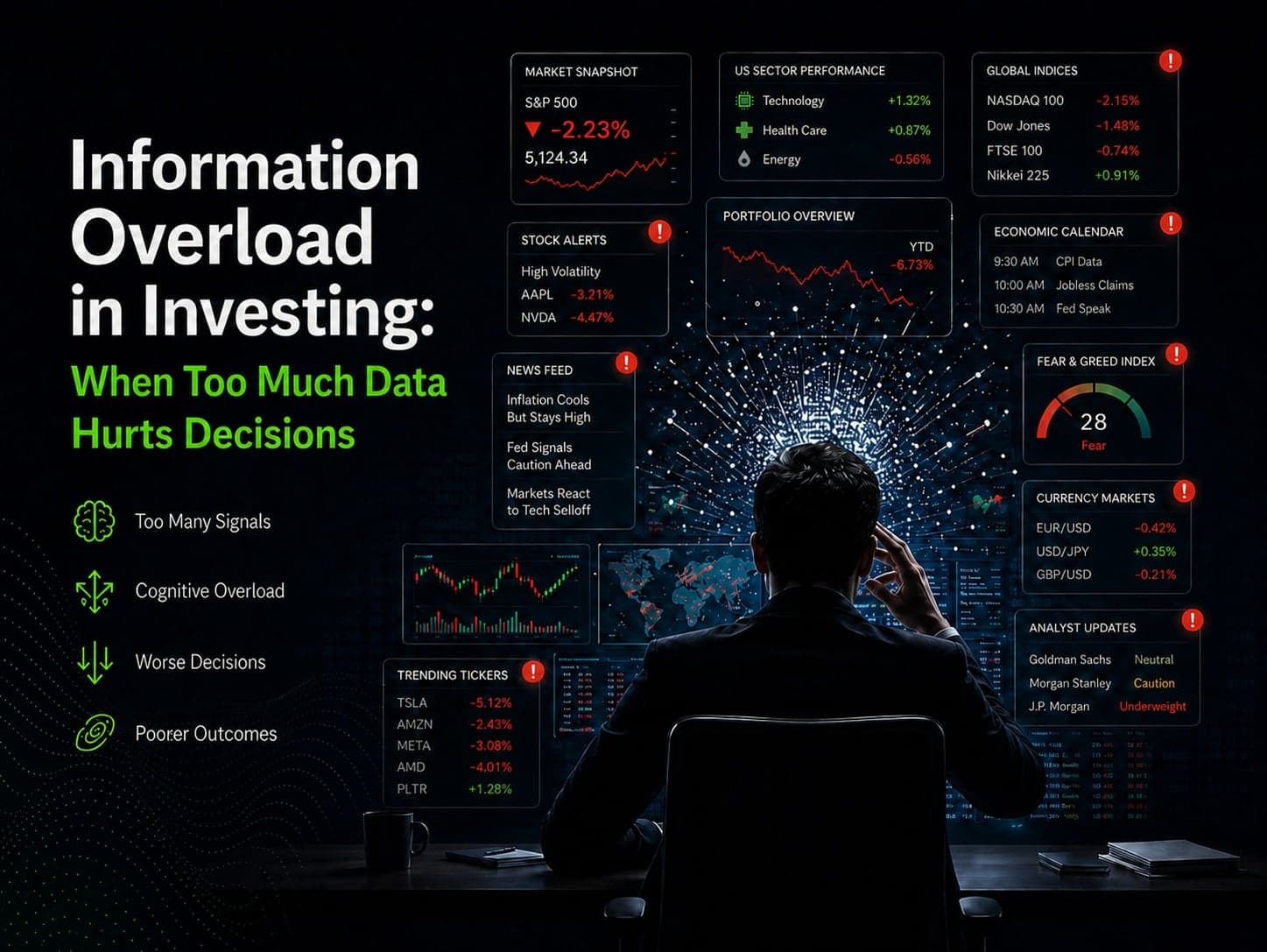
Transparency vs. Simplicity: When Too Much Information Hurts Investors
Why Too Much Information Can Make Investing Harder Over Time
At first glance, more information appears helpful.
- More data should mean better decisions.
- More transparency should reduce uncertainty.
- More visibility should increase confidence.
This assumption feels intuitive.
But in practice, something more complex tends to emerge.
This phenomenon is often described as information overload in investing - where increasing visibility turns into continuous cognitive demand.
Most investors focus on returns, but long-term outcomes are shaped by structure, not just performance. Learn how to compare investments based on cognitive load, volatility experience, and decision pressure - the factors that actually determine sustainability.
Stop Comparing Returns - See What Really MattersWhat Is Information Overload in Investing?
Information overload in investing occurs when the volume and frequency of market information exceed an investor’s ability to process it consistently, leading to increased cognitive load and decision pressure over time.
As information increases, so does the need to interpret it.
As visibility expands, so does the frequency of engagement.
As updates become continuous, uncertainty stops being occasional - and becomes persistent.
Over time, this shift can quietly change the experience of investing.
Clarity does not always increase.
In many cases, it fragments.
Instead of reducing uncertainty, continuous information can transform it into a recurring obligation:
- To check.
- To interpret.
- To reassess.
What begins as access to information can gradually become exposure to ongoing pressure.
The Failure Mode Investors Rarely Anticipate
Investors rarely struggle because they lack information.
They struggle because they cannot stop engaging with it.
When information is constantly available, disengagement becomes difficult.
When every movement is visible, every fluctuation invites interpretation.
When interpretation becomes continuous, mental effort becomes cumulative.
This process rarely feels dramatic.
It builds gradually:
- Shorter intervals between checks
- More frequent reassessment
- Increasing second-guessing
Over time, the effort required to remain consistent begins to rise.
Not because the strategy has changed.
But because the environment surrounding it has.
Eventually, the strain does not appear as confusion.
It appears as fatigue.
What Is Information Density in Investing and Why It Increases Cognitive Load
Not all investment environments expose investors to the same level of informational demand.
Some structures require constant monitoring, frequent interpretation, and ongoing attention.
Others reduce visibility, limit interaction, and allow longer periods without engagement.
The difference is not only about access to information.
It is about how much interaction that information requires over time.
This condition can be understood as information density in investing - the amount and frequency of information an investor must process to remain engaged.
As information density increases, so does the need to:
- Interpret signals
- Filter noise
- Revisit unresolved outcomes
- Sustain attention over time
Individually, each moment may feel manageable.
Collectively, they create sustained cognitive load in investing.
This is one reason information overload in investing often feels exhausting before it feels obvious.
How Too Much Market Information Creates Pressure for Investors
Transparency is often associated with clarity.
But visibility also increases exposure.
When every movement is observable, the investor is repeatedly confronted with uncertainty that has not yet resolved.
Small fluctuations become visible events.
Temporary deviations become recurring signals.
Market information becomes something that must be revisited continuously.
Over time, investing can begin to feel less like a sequence of decisions - and more like an ongoing state of interpretation.
In such environments, pressure does not come from isolated events.
It emerges through repetition.
- Repeated exposure
- Repeated evaluation
- Repeated doubt
Transparency, in this context, does not remove uncertainty.
It distributes it across time.
Reframing Transparency in Investing
Transparency is not inherently beneficial or harmful.
It changes how investing is experienced.
Higher transparency tends to increase:
- Visibility
- Interaction
- Interpretive demand
Lower transparency tends to reduce:
- Immediate feedback
- Engagement frequency
- Continuous evaluation
Neither condition removes uncertainty.
They shape how often the investor must engage with it.
The critical issue is not whether information exists.
It is whether the structure turns that information into ongoing interpretive pressure.
Where Information Overload Often Leads Next
As information exposure increases, interpretation tends to increase with it.
Interpretation leads to evaluation.
Evaluation often leads to decisions.
Over time, this progression can shift investing toward repeated decision-making under uncertainty.
This is where information overload often connects to another structural pressure:
👉 decision fatigue in investing
Not because more information is inherently harmful,
but because sustained interpretation can gradually become sustained decision pressure.
 Written by