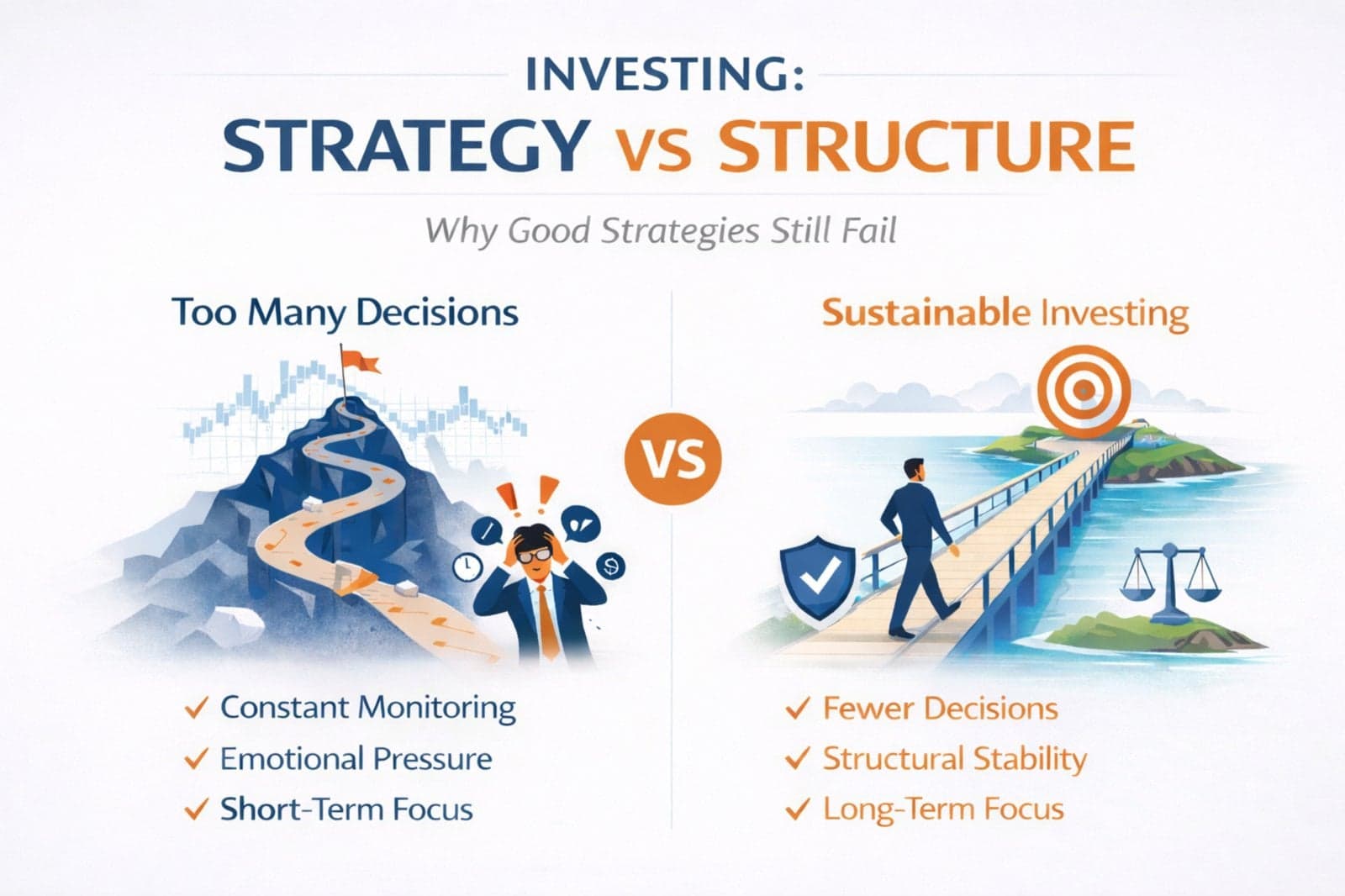
Why Strategy Debates Miss the Real Problem: Investment Structure vs Strategy
Many investors spend years comparing strategies without realizing that the real driver of investment experience may lie elsewhere.
Quick Answer
The difference between investment strategy and investment structure lies in what they control.
An investment strategy defines what decisions are made - such as long-term investing, trend following, or value investing.
An investment structure defines how those decisions are experienced - including how often investors face decisions, how frequently results are evaluated, and how visible short-term volatility becomes.
In practice, many investment difficulties emerge not from the strategy itself, but from the structural conditions surrounding it.
In simple terms: strategy defines the logic of investing, while structure defines the experience of living with that logic over time.
Why Strategy Debates Often Feel Unfinished
Investment strategy debates are among the most common conversations in finance.
Investment discussions often revolve around strategies.
- Active versus passive.
- Long-term investing versus tactical allocation.
- Diversification versus concentration.
These debates can continue for years.
Yet many investors notice something unusual over time.
- Different strategies are tested.
- Different portfolios are constructed.
- Different market philosophies are explored.
But the underlying tension often remains.
- Stress appears in different forms.
- Confidence fluctuates.
- Strategies that once felt rational begin to feel difficult to maintain.
This pattern sometimes leads to a quiet question:
Why do investment strategies fail even when their logic still appears sound?
One possible reason is that strategy debates often overlook something more fundamental - the structural environment in which strategies operate.
The Failure Mode Investors Rarely Anticipate
When investors evaluate strategies, they usually focus on the conceptual logic.
- Expected time horizon.
- Market assumptions.
- Asset allocation.
But the lived experience of investing rarely depends on strategy alone.
In practice, strategy exists inside a broader investment design.
That design determines:
- how frequently investors must interpret market information
- how visible short-term fluctuations become
- how often judgment and action are required
When these structural elements are not considered, strategies that appear stable on paper may feel unstable in real life.
This is one reason why investment strategies fail to persist over time.
The strategy itself may not collapse first.
What often weakens instead is behavioral sustainability in investing - the ability to remain engaged with the same strategy through uncertainty and volatility.
Structural Drivers of Investor Behavior
Investor behavior is often explained through psychology.
Emotions, discipline, and patience are commonly discussed.
Yet behavior also tends to respond to structural constraints embedded in investment architecture.
Several structural drivers frequently shape how strategies are experienced.
Decision Frequency
The number of moments when an investor must make discretionary judgments can influence perceived pressure.
Higher decision frequency in investing tends to increase cognitive load and evaluation stress.
Feedback Visibility
Continuous exposure to market movement can amplify attention toward short-term volatility.
Responsibility Distribution
Some investment designs place most responsibility on the investor, while others distribute decision processes differently.
Liquidity Access
When positions can be adjusted instantly, short-term signals can become more behaviorally influential.
These conditions often act as structural drivers of investor behavior.
They rarely appear in strategy debates, yet they often shape the lived experience of investing more than the strategy label itself.
Investment Structure vs Investment Strategy
Understanding the difference between investment structure and investment strategy can clarify many investment frustrations. Investors often debate strategies while unknowingly operating inside the same structural environment.
Investment Strategy
Refers to the conceptual logic guiding decisions.
Examples include:
- long-term indexing
- value-oriented selection
- trend-based allocation
These describe how markets are approached.
Investment Structure
Refers to the environment in which those decisions occur.
This includes elements such as:
- decision cadence
- monitoring frequency
- information exposure
- execution responsibility
- behavioral exposure to volatility
Two investors may follow the same strategy while operating within completely different structures.
One may interact with the strategy occasionally. Another may confront decisions continuously.
The strategy remains identical.
The investment architecture surrounding it does not.
Why Strategy Debates Often Miss the Structural Layer
Strategy discussions often assume that changing strategy will change the investment experience.
But when the structural environment remains the same, the experience may not change significantly.
An investor might shift strategies while still operating inside:
- frequent monitoring cycles
- high decision density
- constant short-term feedback
When this happens, the underlying pressure tends to remain.
This may explain why strategy debates often fail to resolve the deeper friction investors experience.
The debate focuses on strategy labels.
The lived experience often emerges from structural design.
Most investors focus on returns - but that’s rarely what determines long-term success. What truly matters is how risk behaves, how fees compound, and how volatility impacts real outcomes over time. If you want to evaluate investment options with clarity and precision, you need a structured framework that goes beyond surface-level performance.
The Complete Investment Comparison Framework →Reframing the Strategy Conversation
Recognizing the difference between strategy and structure does not eliminate uncertainty.
Markets remain unpredictable. But the structural conditions surrounding a strategy often determine how that unpredictability is experienced.
This perspective introduces a different lens for evaluating investment approaches.
Instead of asking only:
Which strategy is correct?
Another question becomes visible:
What structural conditions does this investment design require an investor to sustain?
This distinction provides a shared language for comparing different approaches without assuming that one strategy must outperform another.
Where This Structural Question Often Leads
Once the role of structure becomes visible, another tension often appears.
More information is often assumed to improve decision quality.
Yet increased transparency can also increase pressure and cognitive load.
This raises a related structural question:
→ Transparency vs Simplicity: When Too Much Information Hurts Investors
FAQs
What is the difference between investment strategy and investment structure?
Investment strategy describes the conceptual approach guiding investment decisions, while investment structure describes the environment in which those decisions occur - including decision frequency, monitoring intensity, and responsibility distribution.
Why do investment strategies fail even when they seem logical?
Strategies may struggle to persist when the structural environment surrounding them creates sustained behavioral pressure. Factors such as frequent evaluation, continuous volatility exposure, and decision density can influence whether a strategy remains sustainable.
Why do strategy debates often continue without resolution?
Many strategy debates focus on conceptual differences while overlooking structural conditions that shape the actual experience of investing. When structure remains unchanged, switching strategies may not alter the underlying experience.
What are structural drivers of investor behavior?
Structural drivers include elements embedded in investment design, such as decision cadence, information visibility, monitoring frequency, and responsibility load.
What is investment architecture?
Investment architecture refers to the structural design surrounding a strategy - how decisions, information flow, and execution responsibilities are organized within an investment system.
 Written by