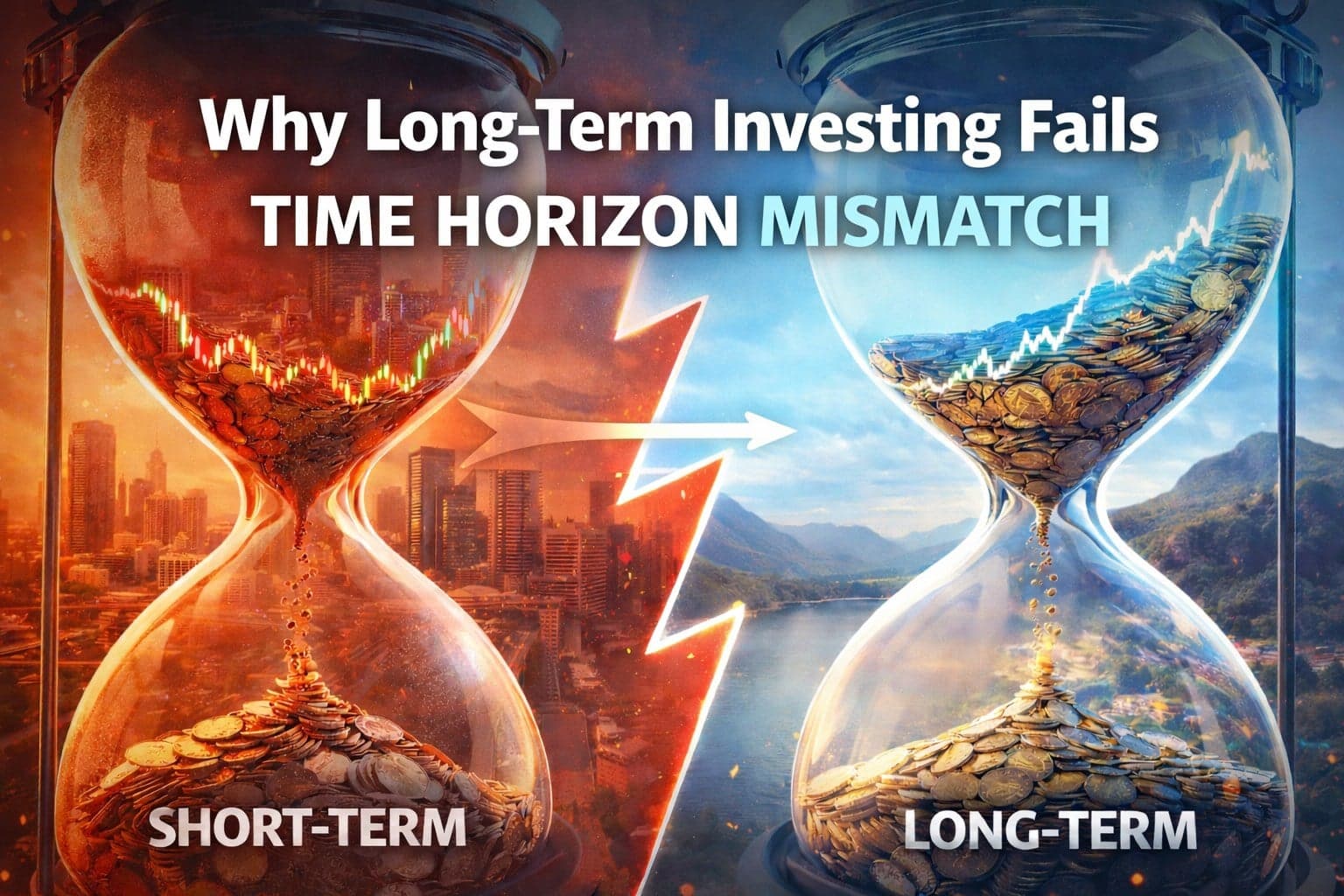
Time Horizon Mismatch in Investing: When Long-Term Intent Collides With Short-Term Evaluation
This article builds on the examination of Decision Frequency by exploring how temporal misalignment creates abandonment pressure - even when long-term intent remains intact.
Key idea: Long-term strategies often fail psychologically not because the thesis breaks, but because the strategy is forced to live inside short-term feedback loops.
Why Long-Term Strategies Start to Feel Wrong
Many investors begin with a long-term intention.
- They accept volatility in theory.
- They commit to patience.
- They understand that markets move in cycles.
Yet over time, something begins to shift.
- Doubt appears earlier than expected.
- Temporary drawdowns feel more significant.
- Short-term fluctuations start to carry disproportionate emotional weight.
The strategy itself may not have changed. The investor’s stated time horizon may not have changed. But the experience begins to feel unstable.
This tension often does not originate from the strategy’s logic. It emerges from the structure in which that strategy is being evaluated.
Time Horizon Mismatch - a structural misalignment between a strategy’s intended duration and the cadence at which it is evaluated - often develops gradually rather than abruptly.
Long-term intent can struggle when it is forced to operate inside short-term feedback loops.
Long-term investing often assumes that time alone stabilizes outcomes. In practice, structure determines how that time is experienced.
The Failure Mode Investors Rarely Anticipate
Time horizon mismatch rarely presents itself as impatience. It presents as reinterpretation.
Short-term feedback begins to redefine long-term commitment:
- Monthly results feel like verdicts.
- Quarterly comparisons feel like structural tests.
- Temporary underperformance begins to resemble permanent failure.
An investor saving for retirement may accept a 20-year horizon in theory, yet still review portfolio movements weekly.
In practice, the investor may still believe in the strategy’s long-term design. But the cadence of evaluation introduces recurring psychological strain.
Over time, this strain accumulates.
The strategy does not collapse first. Endurance does.
This is not a failure of discipline. It is a failure of temporal alignment. When evaluation speed exceeds strategy horizon, abandonment pressure tends to increase.
The Structural Drivers of Time Horizon Mismatch
Time Horizon Mismatch is not a personality trait. It is often embedded in structural design.
Several structural drivers tend to amplify it:
Feedback Speed
When performance is reviewed too frequently relative to the intended horizon, short-term noise becomes dominant.
Comparison Cadence
When external benchmarks or peer comparisons occur at higher frequency than strategy cycles, perceived underperformance intensifies.
Decision Density
Higher required decision frequency - examined in Decision Frequency as a Risk Factor in Investing - can compress perceived time and increase evaluation pressure.
Liquidity Visibility
Continuous access to price movement reinforces short-term salience over long-term structure.
None of these elements imply poor design in isolation. However, when long-term strategies operate inside short-term feedback architectures, sustainability tension often increases.
Structure reshapes perception before outcomes reshape reality.
Reframing Abandonment Pressure
Investors often interpret abandonment as emotional weakness. In practice, abandonment frequently reflects structural friction.
- A long-term strategy evaluated daily can feel unstable.
- A decade-long thesis reviewed monthly can feel fragile.
- A retirement framework tracked hourly can feel broken.
The discomfort may not signal strategic failure. It may signal temporal misalignment.
Patience is often treated as a character trait. In sustained conditions, patience is partially a structural outcome.
When structure and horizon are aligned, endurance tends to feel sustainable. When they are misaligned, strain accumulates - even when logic remains sound.
Frequently Asked Questions
Why do long-term investors abandon strategies early?
Abandonment pressure often emerges when short-term evaluation cycles dominate long-term frameworks. Repeated short-term assessment can amplify perceived instability even when the underlying strategy remains coherent.
What is Time Horizon Mismatch in investing?
Time Horizon Mismatch refers to a structural misalignment between a strategy’s intended duration and the frequency at which it is evaluated.
Is abandoning a strategy always a sign of impatience?
Not necessarily. In many cases, repeated short-term feedback creates cumulative strain over time, which can weaken endurance even when long-term logic remains intact.
Does frequent monitoring affect long-term investing?
Yes. Frequent monitoring increases the salience of short-term volatility. When monitoring cadence exceeds strategy horizon, perceived instability can intensify.
How is Time Horizon Mismatch related to Decision Frequency?
Higher Decision Density - the structurally required rate of discretionary engagement - can compress perceived time and increase evaluation pressure, contributing to temporal misalignment.
Comparing returns alone misses the true drivers of investing success. Fees, risk-adjusted performance, drawdowns, and liquidity all shape what you actually keep over time. If you want a framework that reveals what matters most before you choose between options, this guide lays it out clearly - helping you evaluate investments with depth, not just numbers.
Compare Investments the Smart Way - Beyond Returns →Educational Notice: This page is intended for informational and educational purposes only. It does not provide financial, investment, or legal advice, nor does it recommend specific assets, predict performance, or guarantee outcomes. All investing involves risk, including potential loss of capital.
 Written by