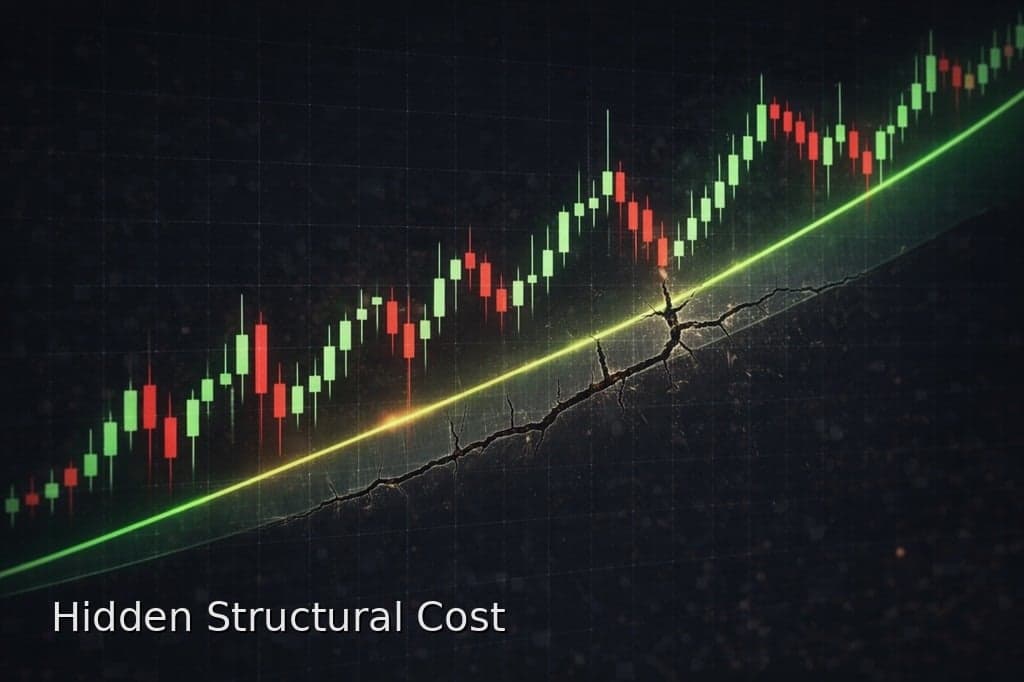
Most Investment Failures Don’t Start With Bad Ideas
Most investment failures don’t begin with bad ideas. They begin with good strategies that become psychologically unsustainable over time. This is uncomfortable to accept because it challenges a deeply held belief: that discipline and intelligence are enough.
In practice, they often aren’t.
When “Good” Stops Being Livable
On paper, a strategy can be sound. It can be coherent, historically validated, and aligned with long-term goals. Yet over time, something changes. Not the logic. Not the assumptions. The experience of living with it.
Uncertainty lasts longer than expected. Feedback becomes delayed, fragmented, or ambiguous. Drawdowns feel heavier - not because they are larger, but because they linger without resolution. What was once manageable starts to drain attention and emotional energy.
This shift rarely announces itself as failure. It appears quietly: hesitation, delayed decisions, a growing urge to “reassess.” By the time abandonment happens, it often feels inevitable.
The Failure Mode Investors Rarely Anticipate
Abandonment is usually explained with surface-level reasons: “The environment changed.” “The strategy stopped working.” “I lost confidence.” These explanations sound rational. But they often obscure a deeper breakdown.
The real failure occurs when psychological endurance runs out before the strategy has time to resolve. Uncertainty requires patience. Patience requires emotional stability. And emotional stability erodes under prolonged ambiguity - especially when no clear feedback arrives to justify continued commitment.
This erosion is gradual. That is why it is rarely recognized while it is happening.
If you’re only comparing returns, you’re ignoring what actually decides outcomes over time: risk, volatility drag, fees, liquidity limits, and the cost of being wrong at the worst moment. This guide gives you a clear framework to compare investment options like a pro — so you judge performance by what you keep, not what a chart suggests.
Investment Comparison Framework →Why Discipline Alone Doesn’t Hold
Discipline is often treated as a personal trait-something investors either possess or lack. This framing is incomplete. Discipline is structurally conditional. It depends on:
- How frequently decisions must be made
- How visible uncertainty is on a day-to-day basis
- How long discomfort must be tolerated without confirmation
Structures that demand constant judgment under unclear conditions quietly exhaust even disciplined investors. When abandonment follows, it looks like a personal shortcoming. In reality, it is often a structural mismatch between strategy demands and human capacity.
Why This Breakdown Is Predictable - but Ignored
What makes this pattern costly is not that it is rare, but that it is predictable in hindsight. Strategies tend to fail not at their weakest analytical points, but at their most psychologically demanding moments: extended drawdowns, long periods of stagnation, environments where responsibility feels personal and signals remain unclear.
These moments test endurance, not intelligence. Yet endurance - unlike expected returns - is almost never considered when strategies are compared.
Reframing Abandonment
Seen through this lens, abandonment is not irrational behavior. It is information. It reveals where a strategy demanded more psychological resilience than the investor could sustainably provide over time.
This does not mean the strategy was wrong. It means sustainability was never part of the comparison. Without acknowledging this, investors often repeat the same cycle: choosing sound strategies that quietly fail in practice - not because of poor judgment, but because structural friction was invisible until it became unbearable.
Where This Leads Next
Abandonment is rarely an isolated issue. It is often the first visible symptom of deeper structural pressure. One of the most common sources of that pressure is decision overload - the cumulative strain created by frequent judgment under uncertainty. That strain deserves to be examined directly.
Frequently Asked Questions
Why do investors abandon strategies that still make sense on paper?
Because sense on paper does not reduce the psychological burden of living with uncertainty. When feedback is delayed and outcomes remain unresolved, endurance can erode even if the logic remains intact. Abandonment often occurs when the experience becomes harder to tolerate than the uncertainty of changing course.
Why doesn’t discipline prevent strategy abandonment over time?
Discipline does not operate in isolation. It is shaped by how frequently decisions must be made, how visible losses feel, and how long ambiguity persists without confirmation. When these demands accumulate, discipline can weaken - not suddenly, but gradually.
When investors abandon a strategy, how do they usually experience that moment?
Rarely as a clear mistake. It more often feels like relief, reassessment, or a reasonable response to changing conditions. By the time the exit occurs, the psychological capacity to continue has often already been depleted.
Is abandoning a strategy a sign that the strategy failed?
Not necessarily. In many cases, it signals that the strategy required a level of psychological endurance that could not be sustained under real-world conditions. The breakdown may originate from structural pressure rather than analytical weakness.
Why does this kind of breakdown usually become obvious only in hindsight?
Because psychological strain accumulates quietly. Small moments of doubt, hesitation, and fatigue rarely feel decisive on their own. Only after the strategy is abandoned does the pattern become visible, making the outcome feel inevitable in retrospect.
 Written by