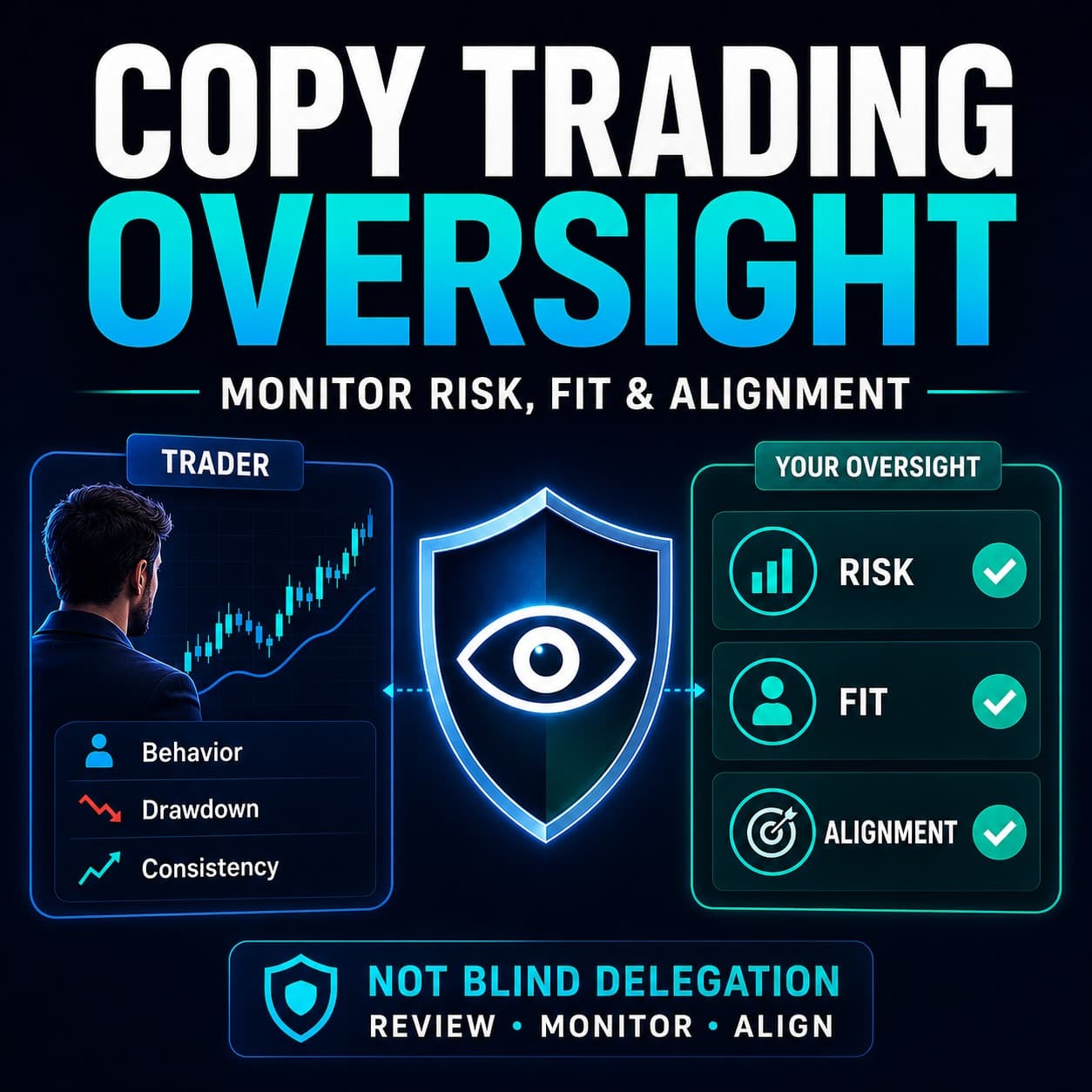
Copy Trading Oversight: Why Users Still Need to Monitor Risk
Copy trading can make trading feel easier to manage.
The user does not need to place every trade manually.
They may not need to follow every market movement minute by minute.
They do not need to make every execution decision alone.
But copy trading is not the same as fully stepping away.
This is where copy trading oversight becomes important.
Many users think copy trading means they can simply choose a trader, activate copying, and stop paying attention.
That is a risky misunderstanding.
Copy trading can reduce execution burden, but it does not remove responsibility.
The user’s role changes from manual execution to selection, allocation, monitoring, risk review, and ongoing alignment.
A copied trader may place the trades.
But the user still chooses who to copy, how much exposure to accept, how often to review performance, and when to reconsider whether the structure still fits.
This is why copy trading oversight matters.
It is not about watching every trade.
It is about avoiding blind delegation.
Why Copy Trading Oversight Matters
Copy trading often feels simple from the outside.
A user chooses a trader.
The system copies trades.
The user follows the results.
But the real experience is more complex.
The copied trader’s behavior may change.
Market conditions may change.
Drawdown may become harder to tolerate.
Trade frequency may increase or decrease.
Risk exposure may no longer feel aligned with the user’s expectations.
This is why oversight should be part of the copy trading process.
Copy trading is not blind trust.
It is delegated execution with ongoing review.
Without oversight, users may continue copying a trader simply because the setup is already active.
They may ignore changes in behavior.
They may overlook higher risk exposure.
They may react emotionally only after losses appear.
They may assume automation means alignment is permanent.
But alignment is not permanent.
A trader who was a good fit yesterday may not remain a good fit forever.
Oversight helps users review whether the copied trader still matches their tolerance, goals, and expectations.
The goal is not to constantly interfere.
The goal is to stay aware.
Direct Answer
Why does copy trading still require oversight?
Copy trading still requires oversight because users remain responsible for trader selection, allocation, risk review, monitoring, and deciding whether a copied trader still fits their tolerance and goals. Copy trading can reduce execution burden, but it does not remove responsibility.
This does not mean users need to manually manage every trade.
It means they should understand what they are copying, review whether risk remains aligned, and avoid treating copy trading as complete passive abandonment.
Copy Trading Reduces Execution Burden, Not Responsibility
Copy trading can reduce one major burden: execution.
The user may not need to decide every entry.
They may not need to manually place each trade.
They may not need to monitor every price movement before taking action.
This can reduce decision pressure.
For many users, that is part of the appeal.
Manual trading often requires repeated decisions under uncertainty. Each entry, exit, stop adjustment, or hesitation can create emotional pressure.
Copy trading changes that experience.
But reducing execution burden is not the same as removing responsibility.
The user still decides:
- Which trader to copy
- How much capital to allocate
- Whether the trader’s style fits their tolerance
- Whether risk exposure remains acceptable
- Whether drawdown behavior is still understandable
- Whether to continue, reduce, or stop copying
This is the key difference.
Execution may be delegated.
Responsibility is not.
Copy trading should reduce decision pressure, not remove awareness.
This is especially important because some users enter copy trading expecting a fully hands-off experience.
That expectation can lead to disappointment or emotional reactions later.
A more realistic view is this:
Copy trading may reduce the number of trading decisions a user makes, but it does not remove the need to review the structure they selected.
Is Copy Trading Completely Passive?
Copy trading may feel more passive than manual trading.
But it is not completely passive.
A user may not be making every trade decision, but they are still participating in a risk structure.
They still need to choose traders carefully.
They still need to understand risk exposure.
They still need to review drawdown.
They still need to monitor whether the copied trader remains aligned.
They still need to decide when changes may be needed.
This is why copy trading should not be treated the same as doing nothing.
A copied trader’s decisions still affect the user’s account experience.
If the trader changes behavior, increases risk, trades more frequently, or enters a difficult market period, the user still experiences the result.
So the better question is not:
Can I stop paying attention?
The better question is:
What level of oversight is reasonable after I start copying?
The answer depends on the user’s tolerance, allocation, trader selection, and risk exposure.
But the principle stays the same:
Copy trading may feel passive, but it still requires awareness, review, and responsibility.
From Manual Execution to Selection and Monitoring
Copy trading changes the user’s role.
Before copy trading, the user may be responsible for manual execution.
They decide what to trade.
They decide when to enter.
They decide when to exit.
They decide how to respond to market movement.
After copy trading, the role shifts.
The user may no longer control each individual trade, but they still control the structure around copying.
That structure includes:
- Trader selection
- Allocation
- Risk review
- Monitoring
- Oversight
- Review conditions
- Stop or adjustment decisions
This is a different kind of responsibility.
It is less about reacting to every market movement.
It is more about reviewing whether the copied trader still fits the user’s expectations.
This connects directly to delegation in investing. Delegation can reduce daily decision pressure, but it still requires clarity about what has been delegated and what remains under the user’s control.
In copy trading, execution may be delegated.
But selection, review, and alignment remain important.
This is why oversight is not a contradiction of automation.
It is what keeps automation connected to the user’s tolerance.
Why Delegation Without Oversight Becomes Blind Trust
Delegation can be useful.
It can reduce emotional pressure.
It can reduce the need for constant manual decisions.
It can help users participate in a more structured way.
But delegation without oversight can become blind trust.
Blind trust happens when users stop asking whether the structure still fits.
They may continue copying because the trader performed well in the past.
They may ignore changes because they assume the system is handling everything.
They may rely on past returns without reviewing current behavior.
They may only react when losses become uncomfortable.
This is not a mature way to approach copy trading.
A more mature approach is structured oversight.
That means the user does not need to control every trade, but they should review important signals over time.
Oversight does not mean panic.
Oversight means awareness.
It means asking:
- Has the trader’s behavior changed?
- Is the risk still understandable?
- Is drawdown still within a range I can tolerate?
- Is trade frequency still aligned with what I expected?
- Am I still comfortable with my allocation?
- Am I reviewing structurally or reacting emotionally?
These questions help prevent copy trading from becoming blind delegation.
The goal is not to watch every trade.
The goal is to avoid copying blindly.
What Users Should Monitor After Copying a Trader
Copy trading oversight becomes most useful when it is practical.
Users do not need vague advice such as “keep an eye on things.”
They need to know what to review.
After copying a trader, users should monitor several key areas.
Trader Behavior
A copied trader’s behavior may change over time.
They may trade more frequently.
They may change position sizing.
They may start trading different assets.
They may hold trades longer than before.
They may react differently during volatility.
A user should review whether the trader still behaves in a way that matches the original reason for copying them.
Drawdown
Drawdown is one of the most important areas to review.
The user should ask whether current drawdown is still within a range they expected or can tolerate.
This does not mean every drawdown is a reason to stop copying.
It means drawdown should be understood before it becomes emotional.
Trade Frequency
Trade frequency affects the user’s experience.
A trader who trades rarely may feel calm but slow.
A trader who trades frequently may create more activity and more emotional pressure.
If trade frequency changes significantly, users should review whether the trader still fits their expectations.
Risk Exposure
Risk exposure can change even when returns look attractive.
Users should monitor whether the trader is taking larger positions, using more aggressive exposure, or becoming more concentrated in certain market conditions.
This is closely connected to copy trading risk management, where allocation, drawdown tolerance, diversification, leverage exposure, and stop conditions all shape the user’s real risk experience.
Allocation
The amount allocated to a copied trader affects how strongly that trader’s behavior impacts the user’s account.
A trader may feel manageable with a smaller allocation and stressful with a larger one.
Users should review whether their allocation still matches their tolerance.
Performance Consistency
Performance should not be reviewed only by looking at total return.
Users should also consider how performance is being produced.
Is it steady?
Is it volatile?
Is it dependent on a few large trades?
Is risk increasing to maintain results?
This connects to copy trading performance beyond returns, where returns are only one part of evaluation.
Fit With Tolerance
A trader’s performance may still look attractive, but the user may no longer feel aligned with the experience.
That matters.
Oversight includes reviewing whether the copied trader still fits the user’s emotional and financial tolerance.
Asset Focus
If a trader changes what they trade, the risk experience may also change.
Different assets can have different volatility, liquidity, spread behavior, and event sensitivity.
Users should know whether the trader’s market focus remains consistent.
Stop or Review Conditions
Users should have conditions that trigger review.
That does not mean reacting to every loss.
It means knowing when to pause and reassess.
Review conditions may include higher-than-expected drawdown, major behavior changes, increased risk exposure, or a loss of alignment with the user’s tolerance.
Trader Behavior Can Change Over Time
One of the reasons oversight matters is that trader behavior is not always static.
A trader may perform one way during calm conditions and another way during volatile conditions.
They may adjust their strategy.
They may increase risk after losses.
They may trade more actively during certain market phases.
They may shift from one asset to another.
They may become less consistent over time.
This does not automatically mean the trader is bad.
It means users should not assume that past behavior will always continue unchanged.
Copy trading oversight helps users notice when the copied structure has changed.
This is especially important because many users choose copied traders based on historical performance.
Historical performance may provide context, but it does not remove the need for ongoing review.
A trader who was a good fit at the beginning may become less aligned later.
That can happen because the trader changes.
It can also happen because the user’s tolerance, capital, goals, or risk comfort changes.
Oversight is the process of checking whether the fit still exists.
Risk Exposure and Drawdown Still Need Review
Risk does not disappear after copying begins.
It simply becomes experienced through another trader’s decisions.
That is why drawdown and risk exposure still need review.
Users should not only ask:
Is this trader profitable?
They should also ask:
How much risk is being taken to produce these results?
A copied trader may show positive historical performance but still create a risk experience that does not fit the user.
The trader may use large positions.
They may tolerate deep drawdowns.
They may hold losing trades longer than expected.
They may increase exposure during difficult periods.
They may rely on volatile market conditions.
These details matter.
Oversight helps users avoid focusing only on surface-level performance.
It helps them review whether the risk behind the performance remains acceptable for their situation.
This is also why a copy trading checklist is useful before copying begins. But the checklist mindset should not stop after setup.
Users should continue reviewing whether the copied trader still fits.
Oversight Does Not Mean Constant Checking
Oversight does not mean staring at the account all day.
It does not mean reacting to every trade.
It does not mean interfering with every position.
It does not mean emotional monitoring.
In fact, constant checking can create its own problems.
It can increase anxiety.
It can make users overreact to normal fluctuations.
It can turn delegated trading back into emotional manual decision-making.
Good oversight is different.
It is structured.
The user reviews the right things at reasonable intervals.
They look for meaningful changes, not every small movement.
They ask whether the structure still fits, rather than reacting to every trade outcome.
Oversight does not mean constant control.
It means periodic review.
This is important because copy trading is often attractive to users who want less decision fatigue.
The goal should not be to replace one kind of stress with another.
This connects to decision fatigue in investing. Too many decisions can weaken discipline, but no review at all can create blind trust.
The balance is structured oversight.
Not constant reaction.
Not passive abandonment.
How SmartT Fits Into Structured Copy Trading Oversight
SmartT should be understood as part of a structured copy trading environment.
It should not be understood as something that removes risk.
It should not be treated as a guarantee of results.
And it should not replace user responsibility.
SmartT becomes relevant when copy trading is treated as structured participation, not passive abandonment.
In that kind of environment, automation can reduce execution burden.
But users still need to think about:
- Which traders they copy
- How much exposure they accept
- Whether the trader still fits their tolerance
- Whether risk behavior remains aligned
- Whether ongoing review is needed
This is where structure matters.
A structured copy trading environment can help users approach copy trading through clearer trader selection, allocation awareness, monitoring habits, risk review, and ongoing alignment.
But the user still needs to understand the responsibility of participation.
SmartT can support a more organized way to participate in copy trading by connecting automation with trader selection, structured monitoring, and risk-aware review.
But it does not remove the need to monitor risk, review alignment, or make responsible decisions.
The goal is not to replace awareness.
The goal is to support more structured participation.
This is closely connected to structure-first investing. In investing and trading, structure often matters as much as the strategy itself, because structure shapes how decisions are made, reviewed, and sustained over time.
Copy Trading Oversight Checklist
Copy trading oversight can be made simpler with a practical checklist.
Users can review copied traders by asking:
Copy Trading Oversight Checklist:
- Is this trader still following a behavior pattern I understand?
- Has trade frequency changed?
- Has drawdown increased beyond what I expected?
- Is risk exposure still aligned with my tolerance?
- Has the trader changed asset focus?
- Is performance still consistent, or is it becoming more volatile?
- Am I still comfortable with my allocation?
- Does this trader still fit my goals and time horizon?
- Am I reviewing based on structure or reacting emotionally?
- Do I understand why I am still copying this trader?
- What conditions would make me reduce exposure?
- What conditions would make me stop copying?
- Is this still a conscious decision, or am I continuing by default?
This checklist does not remove risk.
It helps users avoid blind copying.
The purpose of oversight is not to control every trade.
The purpose is to keep the copy trading structure aligned with the user’s tolerance, expectations, and risk awareness.
Frequently Asked Questions
What is copy trading oversight?
Copy trading oversight means reviewing copied traders over time to check whether their behavior, risk exposure, drawdown, trade frequency, and overall fit remain aligned with the user’s tolerance and goals.
It is not the same as manually managing every trade.
It is a structured review process that helps users avoid blind delegation.
Does copy trading mean I can stop monitoring trades?
No. Copy trading can reduce the need for manual execution, but users still need to monitor trader behavior, risk exposure, drawdown, and whether the copied trader remains suitable over time.
The user may not need to watch every trade, but they should still review whether the structure remains aligned.
Is copy trading completely passive?
Copy trading may feel more passive than manual trading, but it is not completely passive.
Users still need to choose traders carefully, review risk, monitor alignment, and decide when changes may be needed.
Copy trading can reduce execution burden, but it does not remove awareness or responsibility.
Why does copy trading still require responsibility?
Copy trading still requires responsibility because the user decides who to copy, how much exposure to accept, how often to review performance, and when to reduce or stop copying.
The copied trader may control trade execution, but the user still controls participation decisions.
What should users monitor after copying a trader?
Users should monitor trader behavior, drawdown, trade frequency, risk exposure, allocation, performance consistency, asset focus, and whether the trader still fits their tolerance and goals.
The goal is not to react to every trade.
The goal is to notice meaningful changes in structure, behavior, and risk.
How often should users review copied traders?
Users should review copied traders often enough to confirm that behavior, risk, and alignment have not changed.
The right review frequency can depend on the user’s allocation, tolerance, trading style, and the copied trader’s activity level.
The goal is structured review, not emotional reaction to every trade.
Can SmartT replace copy trading oversight?
No. SmartT can support structured copy trading participation, automation, trader selection, and monitoring awareness, but it does not remove risk or replace user responsibility.
Users still need to understand who they copy, how much exposure they accept, and whether the copied structure remains aligned over time.
Closing Insight
Copy trading oversight starts with a simple idea:
The user’s role changes. It does not disappear.
Copy trading may reduce manual execution.
It may reduce some decision pressure.
It may help users participate through a more structured process.
But it does not remove responsibility.
A copied trader may place the trades, but the user still chooses who to follow, how much to allocate, and when to review.
Delegation without oversight can become blind trust.
The mature version of copy trading is not constant control.
It is structured oversight.
That means reviewing trader behavior, risk exposure, drawdown, allocation, performance consistency, and ongoing fit.
The goal is not to watch every trade.
The goal is to avoid copying blindly.
Copy trading is strongest when users understand what they have delegated, what they still control, and when the structure needs review.
That is why oversight matters.
Not because users need to do everything manually.
But because responsible participation still requires awareness.
 Written by