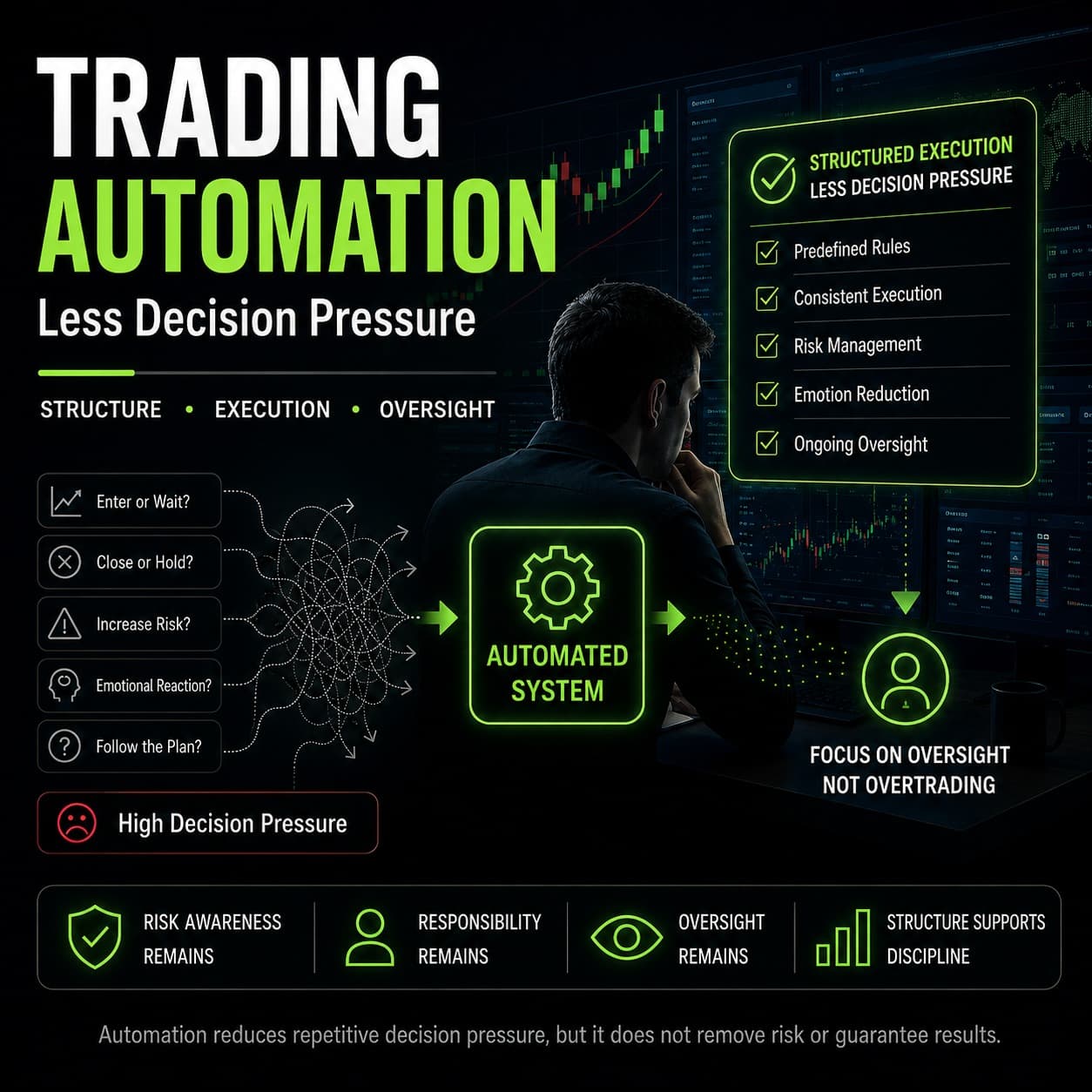
How Trading Automation Reduces Decision Pressure
Trading often looks like a technical activity.
Charts.
Signals.
Entries.
Exits.
Risk levels.
Timing.
But behind every trade, there is another layer most people underestimate:
Decision pressure.
Every trade forces a trader to decide:
Should I enter?
Should I wait?
Should I close early?
Should I increase risk?
Should I ignore this setup?
Should I follow the plan or react emotionally?
Over time, this repeated pressure can become exhausting.
Trading automation can help reduce some of that pressure by turning repeated execution decisions into predefined rules.
But this does not mean automation removes responsibility.
Automation can reduce decision pressure.
It does not remove risk, oversight, or the need to understand how a system works.
Why Trading Creates Repeated Decision Pressure
Trading is not only about market analysis.
It is also about repeated judgment under uncertainty.
Unlike long-term investing, where decisions may happen occasionally, trading often requires frequent decisions:
When to enter
Where to exit
How much to risk
Whether to hold
Whether to stop
Whether to intervene
Whether to trust the system
Each decision may feel small on its own.
But repeated over days, weeks, and months, these decisions can create mental fatigue.
This is why decision pressure matters.
A trader may understand the strategy, but still struggle to apply it consistently when markets move quickly.
This idea is closely connected to decision fatigue in investing, where repeated choices can reduce consistency over time.
Direct Answer
How does trading automation reduce decision pressure?
Trading automation reduces decision pressure by turning repeated execution choices into predefined rules for entries, exits, position sizing, and risk limits.
This can reduce reactive decisions and emotional intervention, but it does not remove market risk, oversight, or user responsibility.
What Decision Pressure Means in Trading
Decision pressure is the mental burden created by having to make repeated choices under uncertainty.
In trading, this pressure is often intensified because:
Markets move fast
Outcomes are uncertain
Losses feel personal
Opportunities appear and disappear quickly
Emotions can interfere with discipline
Every decision may affect account performance
This creates a difficult environment.
Even when a trader has a plan, live market conditions can create doubt.
A setup that looked clear before the market opened may feel much harder to execute when price is moving quickly.
This is where many traders begin to react instead of follow structure.
How Automation Reduces Repetitive Execution Decisions
Automation can reduce decision pressure by handling repetitive execution tasks.
Instead of deciding manually on every trade, an automated system follows predefined rules.
These rules may include:
Entry conditions
Exit conditions
Risk limits
Position sizing logic
Trade filtering
Execution timing
Stop-loss and take-profit behavior
This can reduce the need to constantly ask:
Should I place this trade now?
Should I exit here?
Should I change my plan?
Should I react to this candle?
Should I move my stop?
Automation turns repeated execution choices into rules.
That does not make trading risk-free.
But it can reduce the number of manual decisions required during live market conditions.
Reducing Reactive Decisions Without Removing Responsibility
One of the biggest challenges in trading is reaction.
Markets move.
Emotions rise.
The trader feels pressure to act.
This often leads to reactive decisions.
Examples include:
Closing trades too early
Entering too late
Increasing risk after a loss
Ignoring the original plan
Chasing price movement
Changing strategy during volatility
Automation can reduce this by limiting the number of moments where the user must react manually.
But reducing reaction is not the same as removing responsibility.
The user still needs to understand:
What the system does
When it performs well
When it may struggle
How risk is controlled
When oversight is required
Automation reduces the need to react.
It does not remove the need to review.
Emotional Intervention and Manual Trading Stress
Manual trading can become emotionally heavy because every trade feels like a new decision.
Even with a strategy, the trader may feel pressure at every step:
Before entry
During drawdown
Near take-profit
After a loss
After a winning streak
During news events
During fast price movement
This repeated emotional involvement can create inconsistent behavior.
A trader may follow rules on Monday, break them on Tuesday, reduce risk on Wednesday, and overtrade on Thursday.
The issue is not always lack of knowledge.
Sometimes the issue is decision overload.
Automation can help reduce emotional intervention by making execution more rule-based.
The system follows predefined conditions rather than live emotional reactions.
This can support more consistent participation.
But it does not guarantee better outcomes.
It only changes how decisions are executed.
Decision Frequency as a Hidden Risk Factor
Many investors think risk only comes from market movement.
But decision frequency is also a risk factor.
The more often someone needs to make decisions, the more chances there are for inconsistency.
High decision frequency can lead to:
Fatigue
Overreaction
Second-guessing
Strategy changes
Emotional trades
Poor timing
Loss of discipline
This is why the structure of decision-making matters.
A system that requires constant manual judgment may be harder to sustain than one with clearer execution rules.
This idea is connected to decision frequency as a risk factor.
Decision Frequency as a Risk Factor
Lower decision frequency can support better long-term discipline.
But only if the system itself is structured, monitored, and risk-aware.
Why Automation Supports Decision Sustainability
The value of automation is not only speed.
It is consistency under repeated decision pressure.
A structured automated system can help reduce the need for constant trade-by-trade judgment.
Instead of manually deciding every action, the user can focus more on higher-level review:
Is the system still behaving as expected?
Is risk exposure acceptable?
Are market conditions changing?
Does the structure still fit my tolerance?
Is performance aligned with the system logic?
This is a more sustainable type of decision-making.
Instead of reacting to every market movement, the user reviews the structure over time.
This is where automation can support decision sustainability.
It does not remove decision-making.
It shifts some decisions from live execution to system-level oversight.
What Trading Automation Cannot Remove
Automation has limits.
It cannot remove:
Market risk
Drawdown
Execution risk
Slippage
Liquidity issues
Strategy weakness
Unexpected market events
User responsibility
The need for monitoring
Automation can execute rules.
But it cannot guarantee that the rules will always perform well.
A system may work in one market environment and struggle in another.
For example, a strategy may perform better in stable or trending conditions, but behave differently during high-volatility news events.
This is why automation must be evaluated structurally, not emotionally.
Automation is helpful only when the system behind it is clear, risk-aware, and monitored.
This connects directly to structure-first investing, where decisions are based on system behavior rather than short-term outcomes.
This is where automation becomes most useful: not as a way to avoid decisions entirely, but as a way to move fewer decisions into emotional live-market moments.
How SmartT Fits Into Decision Pressure Reduction
SmartT can be understood as part of a structured approach to automated participation.
Its role is not to remove risk or guarantee results, but to help reduce constant manual decision pressure by connecting automation, execution rules, risk awareness, and ongoing oversight within a more organized framework.
This matters because many users do not struggle only with execution speed.
They struggle with repeated decisions.
When a system helps organize execution and risk behavior, it may reduce some of the pressure created by constant manual trading choices.
But users still need to understand the structure.
They still need to monitor risk.
They still need to evaluate whether the system remains aligned with their tolerance and goals.
SmartT should not be viewed as passive investing.
It is better understood as structured automated participation.
This also connects to the broader misunderstanding around automation and passive investing.
Practical Checklist: When Automation May Help
Trading automation may be useful when decision pressure is coming from repeated execution tasks.
Before using automation, ask:
Automation Decision Pressure Checklist:
Am I making too many reactive trading decisions?
Do I often change plans during live market movement?
Do I close trades emotionally?
Do I increase risk after losses?
Do I struggle to follow predefined rules?
Is my strategy clear enough to automate?
Are risk limits defined before execution?
Can I monitor the system without interfering emotionally?
Do I understand when the system may fail?
Am I using automation to support structure, or to avoid responsibility?
This checklist matters because automation should not be used as an escape from risk.
It should be used only when the system has structure.
Frequently Asked Questions
Does trading automation remove decision-making?
No. Trading automation can reduce repeated execution decisions, but users still need to make higher-level decisions about risk, system selection, monitoring, and suitability.
Can automation reduce trading stress?
Automation may reduce some execution-related stress by limiting reactive decisions, but it does not remove market risk or emotional responsibility entirely.
Is automated trading easier than manual trading?
It can reduce manual workload, but it still requires understanding, risk awareness, and oversight.
Why does decision frequency matter in trading?
High decision frequency can increase fatigue, emotional reactions, and inconsistent behavior. Automation can help reduce repeated execution-level decisions.
Does SmartT remove trading risk?
No. SmartT does not remove trading risk or guarantee outcomes. It can support a more structured approach to automated participation and decision pressure reduction.
Closing Insight
Trading automation is not valuable because it makes trading effortless.
It is valuable when it reduces repeated decision pressure through structure.
Automation can help reduce emotional intervention, reactive execution, and constant trade-by-trade judgment.
But it does not remove risk.
It does not remove responsibility.
It does not replace oversight.
A structured system can reduce decision fatigue without pretending that risk disappears.
Understanding decision pressure helps investors evaluate automation as a structure for participation, not as a shortcut to guaranteed results.
 Written by