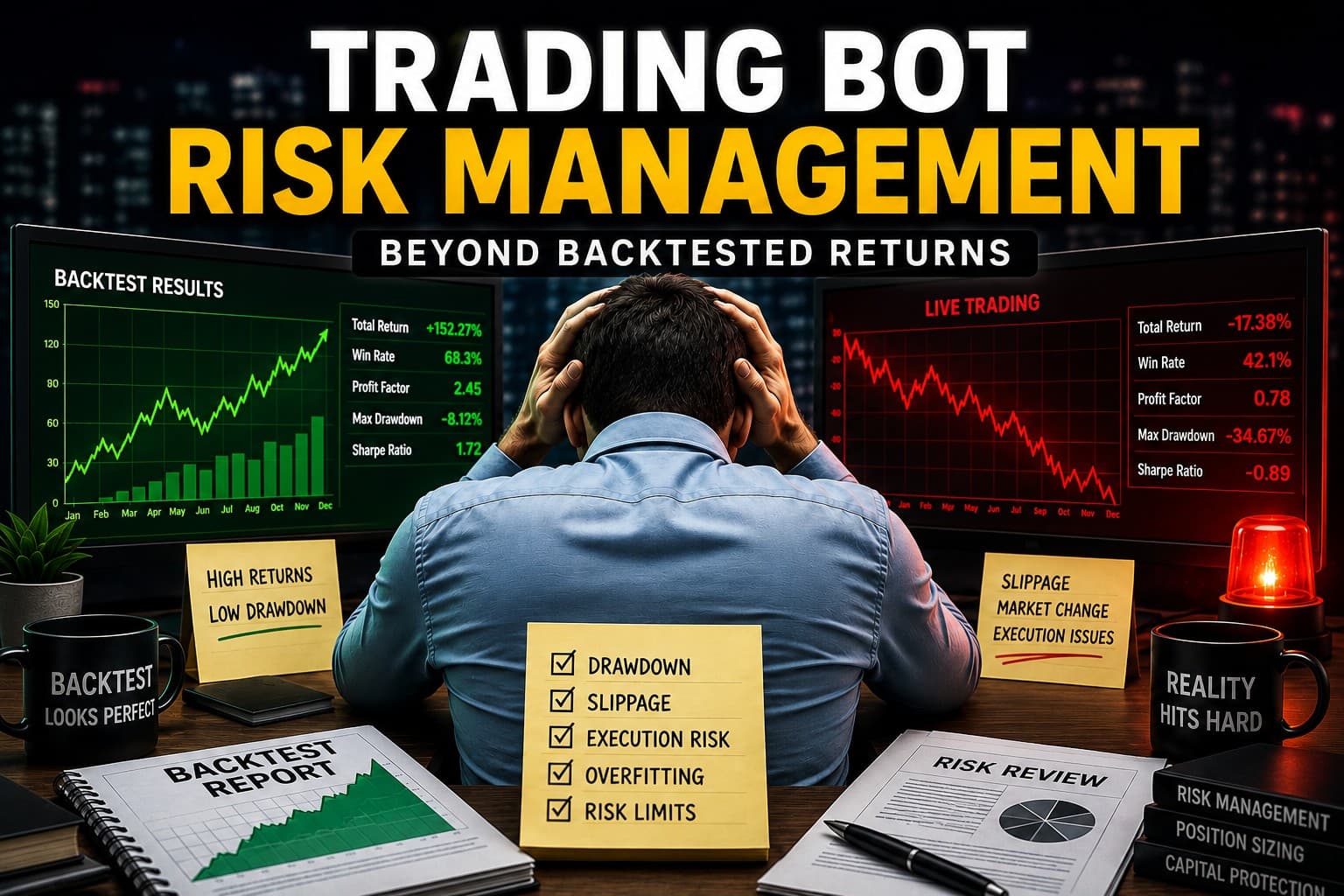
Trading Bot Risk Management: Beyond Backtested Returns
Trading bot performance is often judged by one thing first.
Backtested returns.
That is understandable.
Backtests can look clear.
They can show smooth curves.
They can make a trading bot appear stable, repeatable, and reliable.
But backtested returns are not the same as live risk behavior.
A backtest shows what could have happened under historical assumptions.
Risk management asks a different question:
What might happen when conditions change?
This distinction matters because trading bots do not operate inside clean simulations. They operate in live markets where spreads change, liquidity shifts, execution delays appear, volatility moves quickly, and strategy behavior may not match historical expectations.
A smooth backtest can create confidence.
But it can also create false confidence.
Trading bot risk management begins where backtested performance stops.
Why Backtested Returns Can Create False Confidence
Backtested returns can make risk look simpler than it really is.
A bot may show strong historical performance.
It may appear consistent across a selected time period.
It may show a clean equity curve.
It may seem to recover from losses quickly.
But the backtest is only one view of the system.
It may not fully show:
- Live slippage
- Execution delays
- Spread changes
- Liquidity problems
- Market regime shifts
- Overfitting
- Position sizing risk
- Failure conditions
- Operational issues
- Real capital exposure
This is why backtested returns should not be treated as proof of future reliability.
They are useful.
But they are incomplete.
A trading bot should not be trusted because a backtest looks strong. It should be evaluated by how its risk structure may behave in live conditions.
This is the core of trading bot risk management.
Direct Answer
What is trading bot risk management?
Trading bot risk management means evaluating more than backtested returns. Users should review drawdown, live slippage, execution quality, market regime dependency, overfitting risk, risk limits, human override options, and capital allocation before trusting automated trading results.
This does not make automated trading safe.
It does not guarantee better outcomes.
It helps users understand the risk structure behind the bot before relying on performance charts alone.
What Risk Management Means for Trading Bots
Risk management for trading bots is not only about whether a strategy made money in the past.
It is about how the system behaves when risk appears.
That includes:
- How losses develop
- How drawdown is controlled
- How position sizing works
- How the bot behaves during volatility
- Whether execution assumptions are realistic
- Whether the strategy depends on one market regime
- Whether live results differ from backtests
- Whether the bot can be paused or overridden
- How much capital is exposed to the system
A trading bot is not only a set of entries and exits.
It is a risk structure.
That structure determines how quickly losses can grow, how performance may change under live conditions, and how much pressure the user may experience when markets behave differently from the backtest.
This is why What to Check Before Using a Trading Bot is only the first layer.
The deeper question is not only what the bot does.
It is how the bot manages risk when reality differs from simulation.
Backtest vs Live Trading: Why Results Can Change
Backtests are historical simulations.
Live trading is real-time execution.
The gap between the two can be significant.
A backtest may assume that trades are executed at clean prices.
Live markets may include slippage.
A backtest may use historical data without real-time execution constraints.
Live trading may face latency or order delays.
A backtest may perform well under one market regime.
Live markets may shift into a different regime.
A backtest may look stable because it was optimized to past data.
Live trading may expose that the system was overfit.
This does not mean backtests are useless.
They can help users understand strategy logic and historical behavior.
But backtests should be treated as one input.
Not as proof.
Backtested returns show what could have happened. Risk management asks what may happen when conditions change.
Drawdown: The Risk Behind the Equity Curve
Drawdown is one of the most important risk signals in trading bot evaluation.
A bot may show strong returns, but if those returns came with deep drawdowns, the experience of using that system may be very different from the performance chart.
Drawdown shows how far the system declined from a previous high before recovering.
Users should ask:
- What was the maximum drawdown?
- How often did drawdowns occur?
- How long did recovery take?
- Did the bot reduce risk during drawdown?
- Did it increase exposure after losses?
- Was recovery gradual or aggressive?
- Would the user tolerate similar drawdown with real capital?
Drawdown matters because it reveals the path behind performance.
A smooth final return number can hide uncomfortable periods.
In live conditions, those periods are not just data points.
They are experiences.
The user sees capital decline.
They may question the system.
They may feel pressure to stop or intervene.
They may realize the allocation was too large.
This is why trading bot drawdown should be reviewed before relying on backtested returns.
Live Slippage and Execution Risk
Slippage is one of the biggest differences between backtested performance and live trading behavior.
Slippage happens when the actual execution price differs from the expected price.
In a backtest, entries and exits may look precise.
In live markets, execution can be affected by:
- Market speed
- Liquidity
- Spread changes
- Order size
- Latency
- Volatility
- Broker or platform execution quality
For a trading bot, this matters because automated systems depend heavily on execution.
Even small differences between expected and actual price can change real performance.
This is especially important for strategies that:
- Trade frequently
- Target small price moves
- Use tight stop-losses
- Enter during fast market conditions
- Depend on precise timing
- Operate in low-liquidity periods
A bot that looks profitable in a backtest may become weaker if live execution costs are higher than expected.
This is why trading bot risk management should include live slippage and execution quality, not just historical returns.
Market Regime Dependency
No trading strategy works equally well in every market environment.
A bot may perform well in one market regime and struggle in another.
For example, a bot may work better when markets are:
- Trending
- Liquid
- Stable
- Volatile in a predictable way
- Moving within historical patterns
But the same bot may struggle when markets become:
- Sideways
- Illiquid
- News-driven
- Highly volatile
- Structurally different from the backtest period
This is market regime dependency.
A strong backtest may reflect a market environment that no longer exists.
Users should ask:
- What market conditions created the backtested returns?
- Does the bot depend on trend behavior?
- Does it struggle in sideways markets?
- What happens during sudden volatility?
- Has it been tested across different regimes?
- Does performance depend on one specific historical period?
Live markets test the structure behind the bot, not just the return curve.
Overfitting: When a Bot Is Built for the Past
Overfitting is one of the most important risks in trading bot evaluation.
Overfitting happens when a bot is optimized too closely to historical data.
The strategy may look excellent in a backtest because it has been adjusted to fit the past.
But that does not mean it will adapt well to the future.
Overfitted systems often show:
- Very smooth historical performance
- Too many optimized parameters
- Strong results on one dataset
- Weak behavior outside the tested period
- Poor live results after deployment
- Sensitivity to small market changes
Overfitting can make a trading bot look intelligent in the past and fragile in the present.
This is why users should be cautious when a backtest looks too perfect.
A realistic system should be evaluated not only by its strongest historical period, but by how it behaves when conditions change.
Risk management asks:
Is this bot robust?
Or is it simply fitted to the past?
Risk Limits and Position Sizing
Risk limits are central to trading bot risk management.
A bot can have strong strategy logic but still become dangerous if position sizing is poorly controlled.
Users should ask:
- How much risk is taken per trade?
- Is position sizing fixed or dynamic?
- Does position size increase after losses?
- Is there a maximum drawdown limit?
- Is there a daily or weekly loss limit?
- Is exposure capped?
- What happens during a losing streak?
- Are risk limits hard-coded or adjustable?
Position sizing matters because it determines how much damage a losing period can create.
A system that takes small, controlled risk may behave very differently from one that increases exposure aggressively.
Risk limits matter because automation can execute mistakes faster than manual trading.
If a bot is not properly constrained, it may continue executing under poor conditions until losses become larger than expected.
Automation should not mean uncontrolled execution.
It should mean structured execution.
Execution Failure and System Reliability
Trading bot risk is not only market risk.
It can also be operational risk.
A bot may fail because of:
- Platform downtime
- Internet or server issues
- API problems
- Broker execution delays
- Data feed errors
- Incorrect settings
- Logic failures
- Unexpected order behavior
- Poor synchronization between system and account
These risks may not appear in a backtest.
A historical simulation does not show what happens if execution fails in real time.
Users should ask:
- What happens if the bot disconnects?
- What happens if an order is not executed?
- What happens if market data is delayed?
- Can open positions be managed manually?
- Is there a fail-safe process?
- Are alerts available?
- Can the system be paused quickly?
Execution failure and system reliability are part of risk management.
They should not be ignored just because historical returns look strong.
Human Override and Stop Conditions
Human override is not a weakness in automation.
It is part of responsible risk structure.
Automated systems can reduce manual execution, but users still need ways to intervene when necessary.
This does not mean reacting emotionally to every trade.
It means having predefined review and stop conditions.
Users should consider:
- Can the bot be paused?
- Can risk settings be adjusted?
- What conditions trigger review?
- What level of drawdown requires reassessment?
- What happens if live results deviate from backtest behavior?
- What happens if market conditions change?
- Who is responsible for oversight?
Stop conditions should be considered before emotional pressure appears.
Without stop conditions, users may wait too long to review the system or intervene too quickly based on fear.
The goal is not constant interference.
The goal is structured oversight.
Capital Allocation and Exposure Control
Capital allocation determines how much of the bot’s risk becomes the user’s real exposure.
A bot may show attractive backtested returns.
But the user still decides how much capital to allocate.
This is a user-side risk decision.
Users should ask:
- How much capital is assigned to this bot?
- What happens if the bot reaches its historical drawdown?
- What if live drawdown exceeds the backtest?
- Is exposure concentrated in one system?
- Are multiple bots dependent on the same market regime?
- Can the user tolerate the expected risk?
- Would the allocation still feel acceptable during a losing period?
Capital allocation is not just a funding decision.
It is part of risk management.
This is why broad labels such as “low risk” or “aggressive” can be misleading. A label does not explain how the system behaves, how capital is exposed, or how risk may feel in live conditions.
This connects to Risk Profile Labels Often Mislead Investors.
How SmartT Fits Into Risk-Aware Automation
SmartT can be understood within a risk-aware approach to automated trading.
Its value should not be framed around backtested returns alone, but around structured participation, risk understanding, ongoing evaluation, and awareness of how automated systems behave under live market conditions.
SmartT is not presented here as a way to remove trading bot risk or guarantee outcomes.
It is better understood as part of a structured automation environment where users still need to evaluate risk, monitor alignment, and understand how live conditions can differ from historical simulations.
This matters because automated trading should not be driven by backtest confidence alone.
Users need to understand:
- How risk is structured
- How execution behaves
- How drawdown may develop
- How live conditions may differ
- How much capital is exposed
- When review may be needed
SmartT becomes relevant when automated trading is approached through structure, risk awareness, and ongoing evaluation rather than backtest-driven confidence.
This is also closely connected to Structure-First Investing, where the focus is not only on outcome, but on how participation is structured.
Trading Bot Risk Management Checklist
Before relying on a trading bot, users can review risk through a structured checklist.
Ask:
- What was the maximum drawdown?
- How long did recovery take after drawdowns?
- Does the bot behave differently in live conditions?
- How much slippage can affect performance?
- What market regime does the strategy depend on?
- Is there evidence of overfitting?
- Are risk limits clearly defined?
- How is position sizing controlled?
- What happens if execution fails?
- Can the bot be paused or overridden?
- How much capital is allocated to this system?
- What conditions would trigger a review or stop?
This checklist does not remove risk.
It helps users avoid relying on backtested returns alone.
A bot should be evaluated through structure, not just through historical performance.
For users who are still at the general evaluation stage, What to Check Before Using a Trading Bot can help frame the broader pre-use questions.
Frequently Asked Questions
What is trading bot risk management?
Trading bot risk management means reviewing how an automated system controls risk, including drawdown, position sizing, execution quality, slippage, market dependency, risk limits, and failure conditions.
Are backtested returns enough to evaluate a trading bot?
No. Backtested returns can show historical simulation results, but they do not fully capture live slippage, execution delays, liquidity changes, market regime shifts, or overfitting risk.
Why can live trading results differ from backtests?
Live results can differ because real markets include spread changes, slippage, latency, order execution issues, volatility shifts, liquidity changes, and conditions that backtests may not fully reflect.
What is overfitting in trading bots?
Overfitting happens when a trading bot is optimized too closely to past data, making it appear strong historically while becoming fragile under new market conditions.
Why does slippage matter in automated trading?
Slippage matters because automated systems depend on execution. Even small differences between expected and actual entry or exit prices can change real performance, especially in fast or low-liquidity markets.
Should users monitor trading bots after setup?
Yes. Trading bots still require monitoring because market conditions, execution quality, risk exposure, and system behavior can change over time.
Can SmartT remove trading bot risk?
No. SmartT does not remove trading bot risk or guarantee outcomes. It can support a more structured approach to automated participation, but users still need to understand risk, monitor performance, and evaluate system behavior.
Closing Insight
Backtested returns can be useful.
But they are not enough.
A strong backtest may show what could have happened under historical assumptions.
Live risk management asks what may happen when assumptions change.
What happens when slippage appears?
What happens when volatility shifts?
What happens when liquidity changes?
What happens when execution is delayed?
What happens when the strategy was built too closely for the past?
Trading bot risk management begins where backtested performance stops.
A bot should not be evaluated only by the return curve it produced in simulation.
It should be evaluated by the structure behind that curve.
Drawdown.
Slippage.
Execution.
Risk limits.
Market dependency.
Capital exposure.
Failure conditions.
Understanding trading bot risk management helps users evaluate automated systems through structure, not just historical return curves.
 Written by