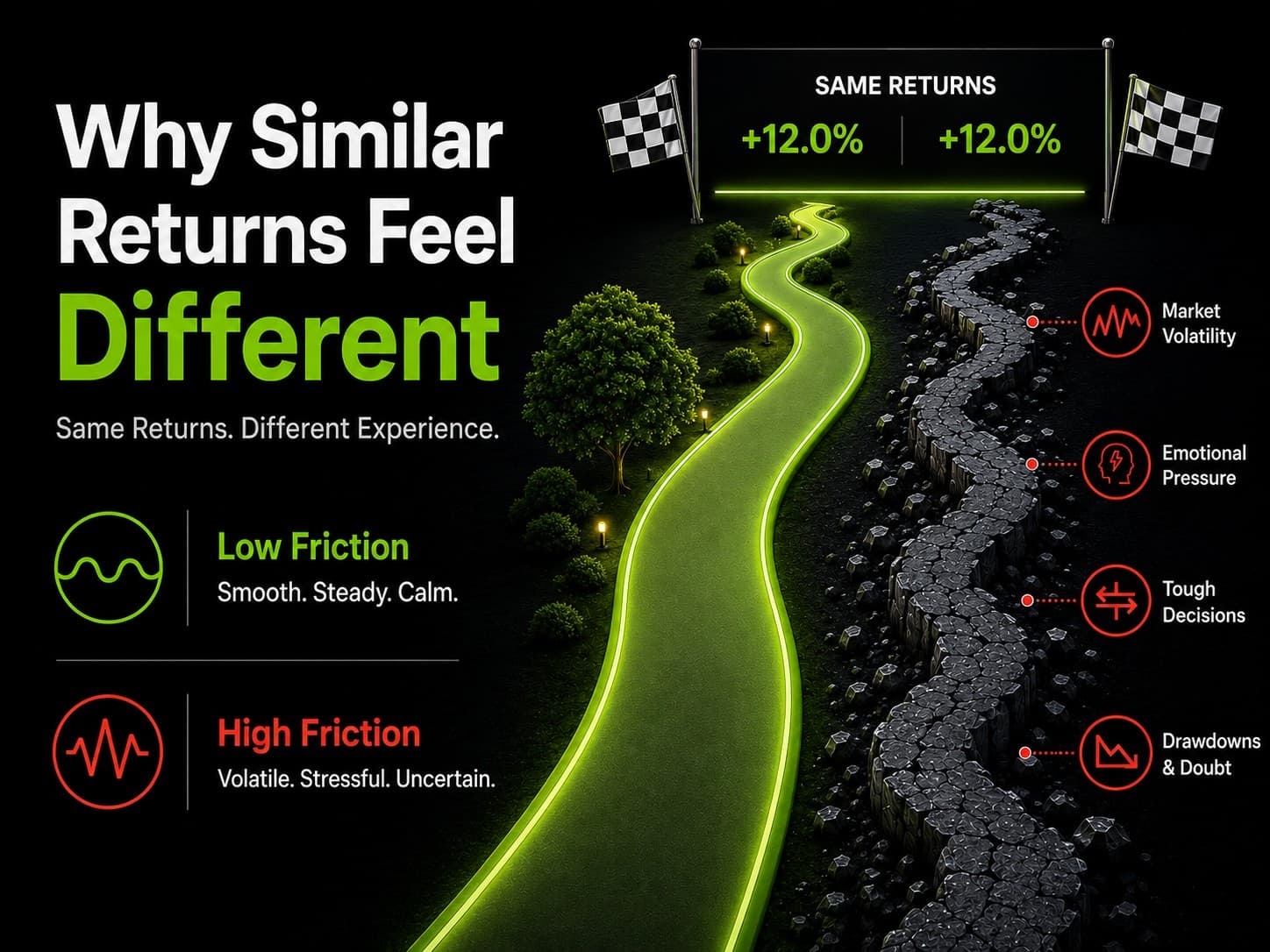
Why Similar Returns Can Feel Completely Different
Two investments can produce similar returns.
The experience of holding them, however, can be fundamentally different.
Why Similar Returns Feel Different Over Time in Investing
Most investment comparisons begin with outcomes.
Returns are placed side by side. Performance is evaluated. Decisions are often framed as a matter of choosing between higher and lower results.
But over time, a different layer of experience begins to surface.
Why similar returns can feel completely different in investing is not a contradiction in outcomes, but a reflection of structural differences in how those outcomes are experienced.
Two investments can deliver similar long-term returns while feeling entirely different to live with. Not because the outcomes differ - but because the path to those outcomes imposes different demands on the investor.
🔹 Direct Answer
Why do similar returns feel different in investing?
Similar returns can feel different because investment structure determines information exposure, decision frequency, and cognitive demand - all of which shape the investor’s lived experience over time.
This difference reflects structural variations in information exposure, decision frequency, and cognitive demand that shape the investor’s lived experience over time.
The difference does not appear in performance summaries.
It appears in the experience of staying invested.
Why Similar Investment Returns Lead to Different Experiences
When two investments produce comparable results, it is often assumed that they are functionally equivalent.
In practice, they are not.
One structure may require:
- Continuous monitoring
- Frequent interpretation of signals
- Ongoing decision-making under uncertainty
Another may operate with:
- Lower visibility
- Fewer intervention points
- Reduced need for active interpretation
Over time, this difference accumulates.
The failure does not emerge as a rejection of the strategy itself.
It emerges as a growing difficulty in sustaining the experience of following it.
Investors may begin to:
- Re-evaluate more frequently
- Question previously accepted assumptions
- Experience increasing cognitive friction
Even when outcomes remain aligned, the experience becomes harder to maintain.
The breakdown is not analytical.
It is structural.
Why Investment Structure Shapes Experience More Than Outcomes
This divergence can be traced to structural differences in how investments distribute demand over time.
Concepts such as information density in investing and decision fatigue in investing help explain this dynamic.
Higher structural intensity often means:
- More frequent exposure to information
- Increased interpretive demand
- Higher decision frequency - often described as decision density in investing
These elements do not change the expected outcome directly.
They define how frequently the investor must engage, interpret, and decide under uncertainty.
Over time, this creates a divergence between outcome and experience:
- Two portfolios may converge in results
- But diverge in cognitive load
- Diverge in required attention
- Diverge in behavioral sustainability
The structure determines the conditions under which the outcome must be endured.
Reframing Returns: Experience Is Not Embedded in Performance
Returns summarize outcomes.
They do not capture:
- The frequency of required decisions
- The intensity of uncertainty exposure
- The cognitive effort required to remain invested
As a result, comparing returns alone can obscure meaningful differences in lived experience.
Two investments with similar outcomes may:
- Demand different levels of engagement
- Create different psychological environments
- Require different forms of endurance
This creates a structural asymmetry:
Similar outcomes do not imply similar investment experiences.
Or more precisely:
Returns do not encode experience. Structure does.
This distinction does not invalidate performance comparisons.
It aligns with a broader structural framework used to analyze how investment conditions shape investor behavior over time.
It introduces a second dimension that performance alone cannot represent.
Why This Difference Matters for Long-Term Investing
As structural demands accumulate, the difference between outcome and experience becomes more visible.
What initially appears as a neutral comparison between similar returns can evolve into:
- Differences in attention stability
- Differences in decision consistency
- Differences in the ability to remain aligned over time
These differences are not immediately apparent.
They emerge gradually, often becoming visible only after sustained exposure.
Understanding this gap shifts the focus of comparison.
From:
What an investment delivers
To:
What an investment requires to stay invested
This shift does not resolve the tension.
It clarifies it.
The broader framework examines how different investment structures distribute these demands - beyond what returns alone can reveal:
❓ Frequently Asked Questions
Why can two investments with the same returns feel different?
Because returns reflect outcomes, not the conditions required to achieve them. Differences in structure - such as information exposure and decision frequency - can create very different lived experiences over time.
Why do similar investment returns feel different over time?
Because the experience of investing is shaped by structure, not just outcomes. Differences in information exposure, decision frequency, and uncertainty can create unequal cognitive and behavioral demands.
Can two investments with the same returns have different risks?
While returns may appear similar, differences in structure can create different behavioral and cognitive demands, which influence how those outcomes are experienced over time.
Does this mean returns are not important?
Returns describe one dimension of investing. This framework highlights that outcomes alone may not reflect the full experience of maintaining an investment over time.
What creates differences in investment experience?
Structural factors such as information density, decision frequency, and exposure to uncertainty influence how demanding an investment feels to maintain, regardless of its outcome.
Is a more demanding investment structure always worse?
This framework does not evaluate structures as better or worse. It describes how different structures distribute cognitive and behavioral demands over time.
🧠 Closing Insight
Investment outcomes can appear similar.
The experience required to reach them often is not.
What matters is not only what an investment delivers -
but what it requires to stay invested long enough for that outcome to be realized.
 Written by