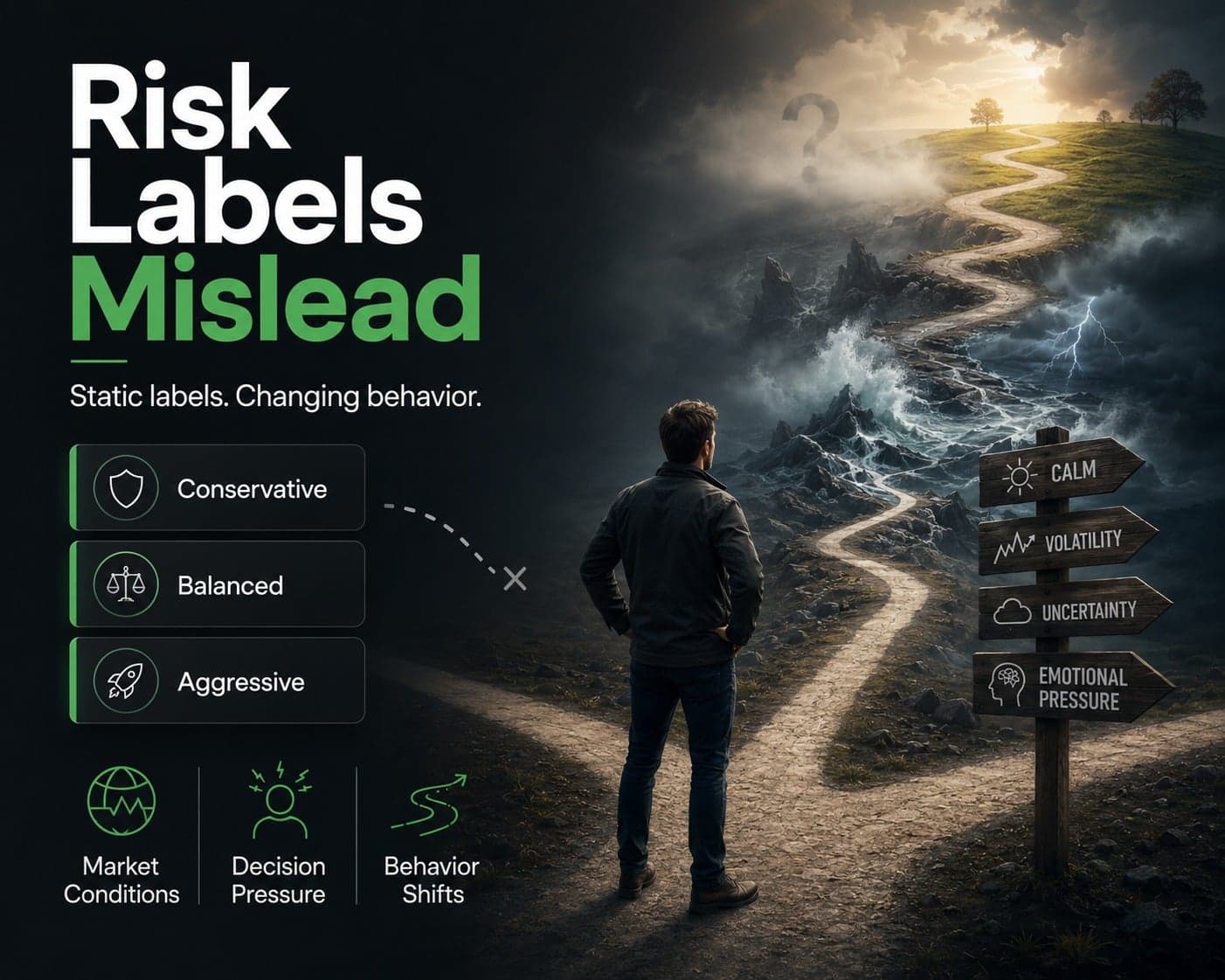
Why “Risk Profile” Labels Often Mislead Investors
Risk profile labels are meant to simplify investing decisions.
In practice, they often oversimplify the very thing they are trying to measure.
Most investors are asked a familiar set of questions before they begin.
- How much risk are you willing to take?
- What level of volatility can you tolerate?
- Are you conservative, balanced, or aggressive?
The answers are used to assign a label.
A risk profile.
It appears precise.
It appears personalized.
It appears stable.
But over time, something begins to break.
This is one reason risk labels can miss the real cost of investing: they describe classification, not the conditions an investor must live with over time.
Why Risk Profile Labels Break Down Over Time in Investing
In practice, investor behavior does not remain stable.
It shifts with:
- Market conditions
- Drawdowns
- Uncertainty duration
- Frequency of decision-making
What feels acceptable in theory often becomes difficult to sustain in reality.
🔹 Direct Answer
Why are risk profile labels misleading in investing?
Risk profile labels are misleading because they assume stable preferences, while real investor behavior changes under different market conditions, information exposure, and decision demands.
This creates a structural mismatch between what investors believe they can tolerate and what they actually experience over time.
The problem is not the concept of risk.
It is the assumption that risk tolerance is fixed.
The Failure Mode Risk Profile Labels Rarely Capture
Risk profiles are typically assigned at a single point in time.
They are based on:
- Self-assessment
- Hypothetical scenarios
- Abstract preferences
But investing does not occur in a static environment.
One structure may expose an investor to:
- Frequent volatility
- Continuous feedback
- Ongoing decision pressure
Another may involve:
- Lower visibility
- Fewer intervention points
- Reduced interaction
Over time, these environments produce different behaviors - even for the same individual.
The label does not adapt.
The experience does.
Risk labels do not fail because they are wrong.
They fail because they are incomplete.
Why Risk Labels Fail to Capture Real Investor Behavior
The limitation is structural.
Risk profiles assume that:
- Preferences remain consistent
- Emotional responses are predictable
- Behavior aligns with stated tolerance
In reality, behavior is shaped by conditions.
Concepts such as information density in investing and decision fatigue in investing help explain why this gap emerges.
Higher exposure to information and more frequent decision-making can:
- Increase perceived risk
- Amplify emotional responses
- Reduce behavioral consistency
Even when the underlying strategy remains unchanged.
The label remains fixed.
The behavior does not.
What Risk Profiles Do Not Measure
Risk profiles describe how investors think they will react.
They do not capture:
- How often uncertainty must be processed
- How frequently decisions must be made - often referred to as decision density in investing
- How long discomfort must be sustained
- How visible losses are over time
These factors shape real behavior far more than static classification.
This creates a disconnect:
- Two investors with the same “risk profile”
- May behave very differently under identical conditions
Or:
- The same investor
- May behave differently under different structures
Reframing Risk: From Labels to Conditions
Risk is often framed as a personal trait.
Something internal.
Something stable.
But in practice, risk is experienced through structure.
It is shaped by:
- Information exposure
- Decision frequency
- Feedback intensity
This does not invalidate the idea of risk tolerance.
It reframes it.
From:
Who the investor is
To:
What the investment demands
Why Risk Profile Labels Matter Less Than Real Investment Conditions
When risk is reduced to a label, a critical dimension is lost.
The ability to sustain behavior under real conditions.
This can lead to:
- Misaligned expectations
- Overconfidence in strategy fit
- Unexpected behavioral breakdowns
The issue is not incorrect labeling.
It is incomplete modeling.
A broader investment comparison framework provides a way to examine how investment structures shape real investor behavior over time.
Understanding this gap shifts the question:
From:
“What is my risk profile?”
To:
“What will this structure require from me over time?”
This shift does not eliminate uncertainty.
It makes it visible.
❓ Frequently Asked Questions
What is a risk profile in investing?
A risk profile is a classification that attempts to define how much risk an investor is willing to take, typically based on questionnaires and self-assessment.
Why can risk profiles be misleading?
Because they assume stable preferences, while actual investor behavior changes under real market conditions and structural demands.
Why do risk profiles fail under real market conditions?
Risk profiles can fail under real market conditions because they rely on static assumptions, while investor behavior often shifts when volatility, uncertainty, information exposure, and decision pressure increase.
Can a risk profile be accurate at first but fail later?
Yes. A risk profile may reflect an investor’s stated tolerance at one point in time, but that tolerance can shift when market conditions, feedback frequency, and emotional pressure change.
Can risk profiles predict investor behavior?
Risk profiles attempt to predict behavior, but they are limited because they rely on static assumptions. Real investor behavior changes based on market conditions, information exposure, and decision demands.
What matters more than a risk label?
The conditions under which risk is experienced - including how often decisions are required and how uncertainty is encountered over time.
🧠 Closing Insight
Risk is often described as a number.
Or a category.
But in practice, it is an experience.
And that experience is shaped less by labels and more by the conditions under which investing actually unfolds.
Labels describe risk.
Structure shapes whether it can be endured.
 Written by